
Corvidae (Crows, Jays, and Magpies)
- Phylogenetic placement: Passeri: Corvides: Corvoidea
- Distribution: cosmopolitan except Antarctica and New Zealand (extinct and reintroduced)
- Number of extant genera: 22
- Number of extant species: 135
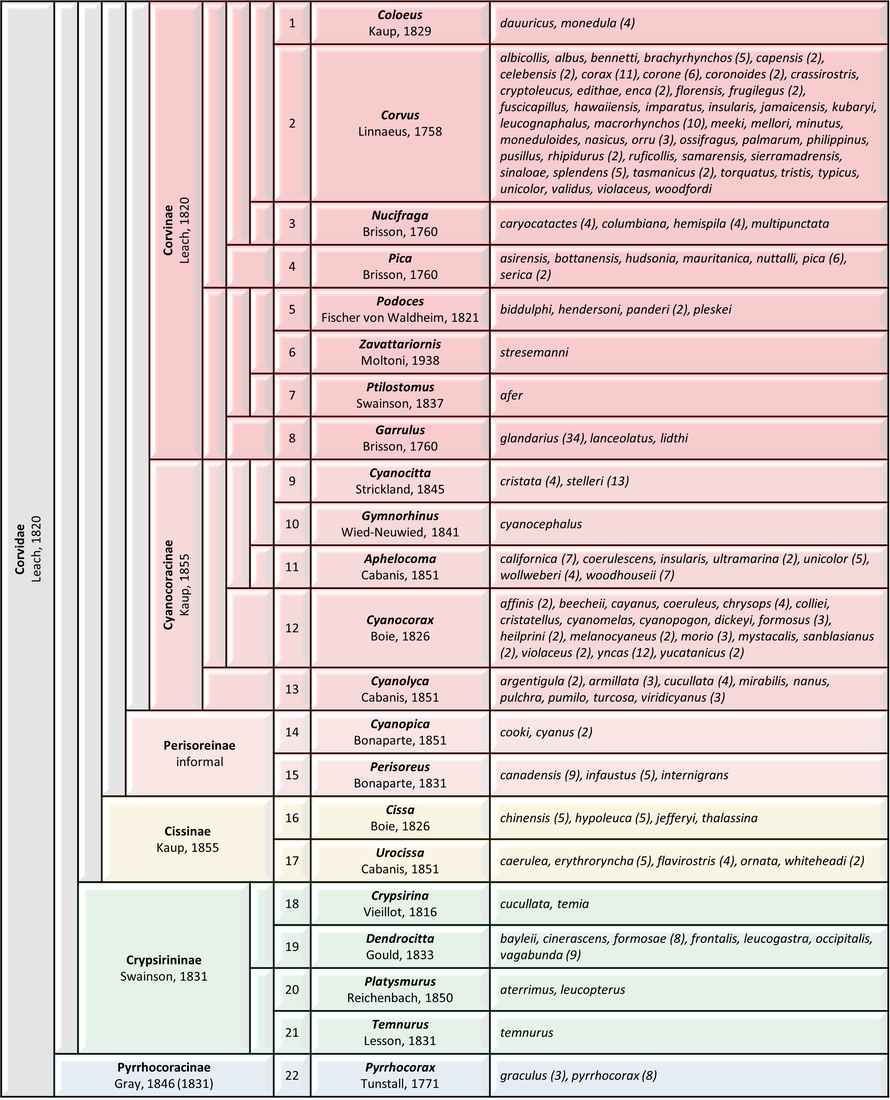
Traditional genus-level classification of extant Corvidae following the AviList checklist v2025. (link) The number of subspecies is given in parentheses. The phylogenetic arrangement is based on McCullough et al. (2023), and largely matches that of the BOW Phylogeny Explorer tree v1.6, except for the placements of Dendrocitta, Pica, and Zavattariornis. (link) Note that McCormack et al. (2023) proposed to split Cyanolyca cucullata (s.l.) into two species, C. cucullata (s.str.) and C. mitrata.
References [annotated]
Bonaccorso E (2009), Historical biogeography and speciation in the Neotropical highlands: Molecular phylogenetics of the jay genus Cyanolyca, Mol. Phylogenet. Evol. 50, 618-632. (abstract) [note: provided an undated subspecies-level phylogeny of all nine Cyanolyca species]
Bonaccorso E, and Peterson AT (2007), A multilocus phylogeny of New World jay genera, Mol. Phylogenet. Evol. 42, 467-476. (abstract)
Bonaccorso E, Peterson AT, Navarro-Sigüenza AG, and Fleischer RC (2010), Molecular systematics and evolution of the Cyanocorax jays, Mol. Phylogenet. Evol. 54, 897-909. (abstract)
Ericson PGP, Jansén AL, Johansson US, and Ekman L (2005), Intergeneric relationships of
the crows, jays, magpies and allied groups (Aves: Corvidae) based on nucleotide sequence data, J. Avian Biol. 36, 222-234. (free reading) [note: provided a phylogeny of 16 corvid genera; considered Calocitta a
separate genus from Cyanocorax; missed Coleus, Cyanolyca, Cypsirina, Dendrocitta, Platysmurus, and Zavattariornis]
Fernando SW, Peterson AT, and Li SH (2017), Reconstructing the geographic origin of the New World jays, Neotrop. Biodivers. 3, 80-92. (pdf) [note: provided a genus-level timetree of all Corvidae except Coleus and Zavattariornis; provided a fully resolved genus-level timetree of New World jays, subfamily Cyanocoracinae]
Garcia-Porta J, Sol D, Pennell M, Sayol F, Kaliontzopoulou A, and Botero CA (2022), Niche expansion and adaptive divergence in the global radiation of crows and ravens, Nat. Commun. 13, e:2086. (supplementary information). (free pdf) [note: provided a species-level phylogeny of Corvidae]
Haring E, Gamauf A, and Kryukov, A (2007), Phylogeographic patterns in widespread corvid birds, Mol. Phylogenet. Evol. 45, 840-862. (abstract)
Haring E, Däubl B, Pinsker W, Kryukov A, and Gamauf A (2012), Genetic divergences and intraspecific variation in corvids of the genus Corvus (Aves: Passeriformes: Corvidae) – a first survey based on museum specimens, J. Zool. Syst. Evol. Res. 50, 230-246. (abstract)
Jønsson KA, Irestedt M, Fuchs J, Ericson PGP, Christidis L, Bowie RCK, Norman JA, Pasquet E, and Fjeldså J (2008), Explosive avian radiations and multi-directional dispersal across Wallacea: Evidence from the Campephagidae and other crown Corvida (Aves), Mol. Phylogenet. Evol. 47, 221-236. (abstract)
Jønsson KA, Fabre PH, Ricklefs RE, and Fjeldså J (2011), Major global radiation of corvoid birds originated in the proto-Papuan archipelago, Proc. Natl. Acad. Sci. 108, 2328-33. (pdf)
Jønsson KA, Fabre PH, and Irestedt M (2012), Brains, tools, innovations and biogeography in crows and ravens, BMC Evol. Biol. 12, e:72. (free pdf)
Jønsson KA, Fabre PH, Kennedy JD, Holt BG, Borregaard MK, Rahbek C, and Fjeldså J (2016), A supermatrix phylogeny of corvoid passerine birds (Aves: Corvides), Mol. Phylogenet. Evol. 94, 87-94. (abstract)
Jønsson KA, Christidis L, Cibois A, Fuchs J, Orestedt M, Kennedy JD, and Fjeldså J (2020), Cohort Corvides: the crow-like passerines. In: “The largest avian radiation. The evolution of perching birds, or the order Passeriformes. (Fjeldså J, Christidis L, and Ericson PGP, eds.). Lynx Edicions, Barcelona. pp. 131-169. (link)
Kryukov AP, Spiridonova LN, Mori S, Arkhipov VY, Red‘kin YA, Goroshko OA, Lobkov EG, and Haring E (2017), Deep phylogeographic breaks in Magpie Pica pica across the Holarctic: concordance with bioacoustics and phenotypes, Zool. Sci. 34, 185-200. (abstract)
Kryukov AP, Goroshko OA, Arkhipov VY, Red‘kin YA, Lee S, Dorda BA, Kryukov KA, Kapun M, and Haring E (2022), Introgression at the emerging secondary contact zone of magpie Pica pica subspecies (Aves: Corvidae): Integrating data on nuclear and mitochondrial markers, vocalizations and field observations, Org. Divers. Evol. 22, 1037-64. (free pdf)
Kryukov AP, Krykov KA, Collier K, Fang B, and Edwards SV (2024), Mitogenomics clarifies the position of the Nearctic magpies (Pica hudsonia and Pica nuttali) within the Holarctic magpie radiation, Curr. Zool. 70, 618-630. (free pdf) [note: provided evidence that Pica hudsonia and P. nuttali are sister species; together the Nearctic species form the sister-clade to P. pica]
Kryukov AP (2025), Genetic variation and phylogeography of the magpie‘s genus Pica in the Holarctic, Vavilov J. Genet. Breed. 29, 578-593. (free pdf) [note: provided a summary of previous publications]
McCormack JE, Hill MM, DeRaad DA, Kirsch EJ, Reckling KR, Mutchler MJ, Ramirez BR, Campbell RML, Salter JF, Pizarro AK, Tsai WLE, and Bonaccorso E (2023), An elevational shift facilitated the Mesoamerican diversification of Azure-hooded Jays (Cyanolyca cucullata) during the Great American Biotic Interchange, Ecol. Evol. 13, e:10411. (pdf) [note: provided a timetree of all nine Cyanolyca species; proposed to split C. cucullata (s.l.) into two species, C. cucullata (s.str.) and C. mitrata]
McCullough JM, Oliveros CH, Benz BW, Zenil-Ferguson R, Cracraft J, Moyle RG, and Andersen MJ (2022), Wallacean and Melanesian islands promote higher rates of diversification within the global passerine radiation Corvides, Syst. Biol. 71, 1423-39, [and suppl. figure S6]. (free pdf)
McCullough JM, Hruska JP, Oliveros CH, Moyle RG, and Andersen MJ (2023), Ultraconserved elements support the elevation of a new avian family, Eurocephalidae, the white-crowned shrikes, Ornithology 140, e:ukad025. (free pdf) [note: provided a genus-level timetree of Corvidae]
Oliveros CH, Field DJ, Ksepka DT, Barker KF, Aleixo A, Andersen MJ, Alström P, Benz BW, Braun EL, Braun MJ, Bravo GA, Brumfield RT, Chesser RT, Claramunt S, Cracraft J, Cuervo AM, Derryberry EP, Glenn TC, Harvey MG, Hosner PA, Joseph L, Kimball RT, Mack AL, Miskelly CM, Peterson AT, Robbins MB, Sheldon FH, Silveira LF, Smith BT, White ND, Moyle RG, and Faircloth BC (2019), Earth history and the passerine superradiation, Proc. Natl. Acad. Sci. U.S.A. 116, 7915-25. (pdf) [note: provided a passerine timetree including two corvid species, Corvus corax and Pyrrhocorax pyrrhocorax]
Song G, Zhang R, Alström P, Irestedt M, Cai T, Qu Y, Ericson PGP, Fjeldså J, and Lei F (2018), Complete taxon sampling of the avian genus Pica (magpies) reveals ancient relictual populations and synchronous Late-Pleistocene demographic expansion across the Northern Hemisphere, J. Avian Biol. 49, e:01612. (pdf) [note: provided a subspecies-level timetree of the genus Pica, based on two mitochondrial genes; proposed to recognise seven Pica species: asirensis, bottanensis, hudsonia, mauritanica, nuttalli, pica, and serica]
Stiller J, Feng S, Chowdhury AA, Rivas-González I, Duchêne DA, Fang Q, Deng Y, Kozlov A, Stamatakis A, Claramunt S, Nguyen JMT, Ho SYW, Faircloth BC, Haag J, Houde P, Cracraft J, Balaban M, Mai U, Chen G, Gao R, Zhou C, Xie Y, Huang Z, Cao Z, Yan Z, Ogilvie HA, Nakhleh L, Lindow B, Morel B, Fjeldså J, Hosner PA, da Fonseca RR, Petersen B, Tobias JA, Székely T, Kennedy JD, Reeve AH, Liker A, Stervander M, Antunes A, Tietze DT, Bertelsen M, Lei F, Rahbek C, Graves GR, Schierup MH, Warnow T, Braun EL, Gilbert MTP, Jarvis ED, Mirarab S, and Zhang G (2024), Complexity of avian evolution revealed by family-level genomes, Nature 629, 851-860. (pdf) [note: provided an avian timetree including the following corvid species: Aphelocoma coerulescens, Corvus brachyrhynchos, C, (corone) cornix, and C. moneduloides]
Wolf P, Töpfer T, Kryukov A, Aoki D, and Haring E (2026), Phylogenetic relationships within the genus Garrulus Brisson, 1760 (Corvidae, Aves) with special emphasis on the Garrulus glandarius complex based on mitochondrial marker sequences, Ann. Nat. Hist. Mus. Vienna 127, 13-37. (free pdf) [note: provided an undated phylogeography of Garrulus glandarius; recognised eight subspecies groups]
Zhang R, Song G, Qu Y, Alström P, Ramos R, Xing X, Ericson PGP, Fjeldså J, Wang H, Yang X, Kristin A, Shestopalov AM, Choe JC, and Lei F (2012), Comparative phylogeography of two widespread magpies: Importance of habitat preference and breeding behavior on genetic structure in China, Mol. Phylogenet. Evol. 65, 562-572. (abstract) [note: provided a dated phylogeography of two species, Cyanopica cyanus and Pica pica; Cyanopica cyanus comprises two, and Pica pica six subspecies]
Zhang Y, Song S, Zhang W, Liu Y, and Li S (2026), Characterization and geographical variation of the mitochondrial genome in the Azure-winged Magpie (Cyanopica cyanus), BMC Genomics 27, e:292. (free pdf ) [note: provided an incomplete, mitogenome-based corvoid timetree]