
Bernieridae (Malagasy Warblers and Tetrakas)
- Phylogenetic placement: Passeri: Passerides: Sylviida: Locustelloidea
- Distribution: endemic to Madagascar
- Number of extant genera: 8
- Number of extant species: 11
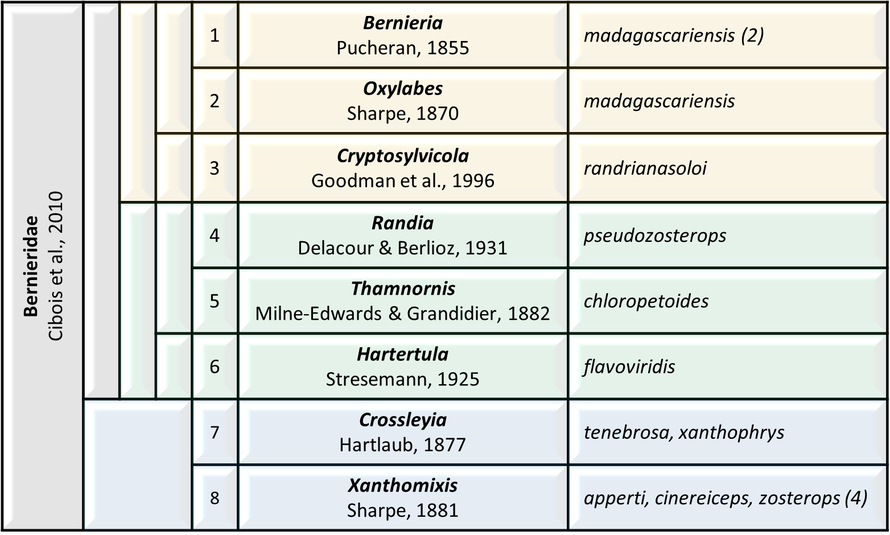
Traditional genus-level classification of extant Bernieridae following the AviList checklist v2025. (link) The number of subspecies is given in parentheses. The phylogenetic arrangement is based on Alström et al. (2013) and Younger et al. (2019), and matches that of the BOW Phylogeny Explorer tree v1.6. (link)
Bibliography [annotated]
Alström P, Olsson U, and Lei F (2013), A review of the recent advances in the systematics of the avian superfamily Sylioidea, Avian Res 4, 99-131. (pdf) [note: treated Bernieria madagascariensis, Crossleyia xanthophrys, Hartertula flavoviridis, Oxylabes madagascariensis, Thamnornis chloropetoides, and Xanthomixis apperti]
Beresford P, Barker FK, Ryan PG, and Crowe TM (2005) African endemics span the tree of songbirds (Passeri): molecular systematics of several evolutionary enigmas, Proc. R. Soc. B 272, 849-858. (abstract) [note: treated Thamnornis chloropetoides and Xanthomixis zosterops]
Cibois A, David N, Gregory SMS, and Pasquet E (2010), Bernieridae (Aves: Passeriformes): a family-group name for the Malagasy sylvioid radiation, Zootaxa 2554, 65-68. (abstract) [note: introduced the family-group name Bernieridae]
Oliveros CH, Field DJ, Ksepka DT, Barker KF, Aleixo A, Andersen MJ, Alström P, Benz BW, Braun EL, Braun MJ, Bravo GA, Brumfield RT, Chesser RT, Claramunt S, Cracraft J, Cuervo AM, Derryberry EP, Glenn TC, Harvey MG, Hosner PA, Joseph L, Kimball RT, Mack AL, Miskelly CM, Peterson AT, Robbins MB, Sheldon FH, Silveira LF, Smith BT, White ND, Moyle RG, and Faircloth BC (2019), Earth history and the passerine superradiation, Proc. Natl. Acad. Sci. U.S.A. 116, 7915-25. (pdf) [note: treated Oxylabes madagascariensis and Xanthomixis zosterops]
Younger JL, Block NL, Raherilalao MJ, Maddox JD, Wacker KS, Kyriazis CC, Goodman SM, and Reddy S (2019), Diversification of a cryptic radiation, a closer look at Madagascar's recently recognized bird family, bioRxiv [preprint] (pdf) [focal taxa: all Bernieridae species] [This preprint has not been published in a peer-reviewed journal since its initial release. Readers are therefore advised to interpret its findings with appropriate caution]