
Descriptive mitogenomics
Avian mitogenome organisation
In the avian ground pattern, the mitogenome contains 37 coding genes (two rRNA genes, 22 tRNA genes, and 13 protein-coding genes) and an elongate non-coding control region. In addition, an extended tandem duplication might have been present. This ancient pattern (except the tandem duplication) is typical for almost all metazoans (Bernt et al., 2014).
Short mitochondrial-derived peptides like MOTS-c may also pertain to the ground pattern of birds (Shu et al., 2025). Even though the mini-gene is located in the mitogenome, translation happens in the cytoplasm.
Compared to other vertebrates, in avian mitogenomes the positions of the adjacent gene clusters [CYB:T:P] and [ND6:E] are interchanged, with the derived gene order [CYB:T:P:ND6:E] representing an avian ground-pattern apomorphy (Montaña-Lozano et al., 2022).
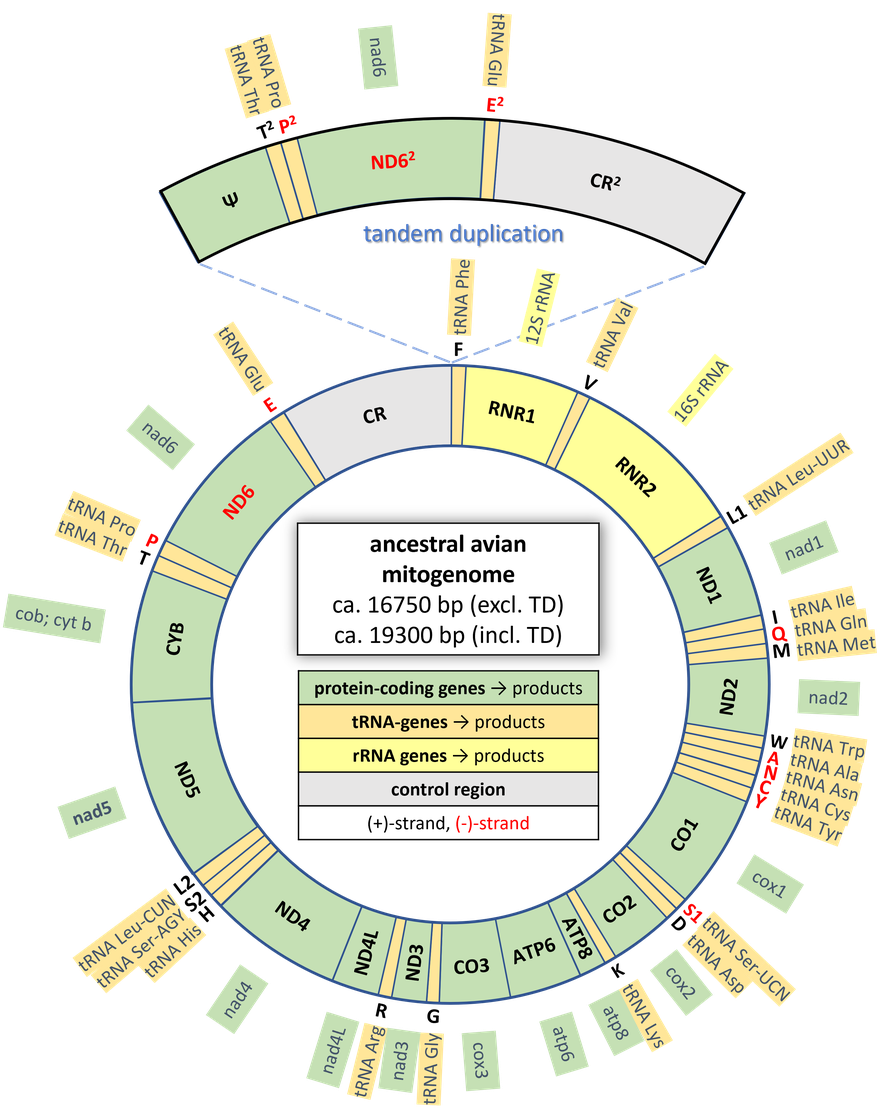
Mitochondrial gene map, depicting the putative ancestral avian pattern (not to scale). The tandem duplication (TD), extending between the non-coding control region (CR) and gene F, is shown separately as it is unclear whether it pertains to the avian ground pattern. When fully developed, the TD contains a pseudogene Ψ (a degenerate copy of CYB), four functional genes (T, P, ND6 and E), and an extended control region (Urantówka et al., 2020). Note: tRNA genes are depicted by their one-letter amino-acid code; red colour indicates genes that are encoded on the secondary (-) strand; spacers and overlaps are not considered.
Avian tandem duplication
Most avian mitogenomes are distinguished from typical vertebrate mitogenomes by the presence of a large tandem duplication comprising the control region and several adjacent genes (Urantówka et al., 2018, 2020, 2021; Mackiewicz et al., 2019). Dating back to Haring et al. (1999) this region is also referred to as “pseudo-control region”. Duplicated genes are often nearly identical to their counterpart, a phenomenon referred to as “sequence homogenisation” or “concerted evolution” (Cadahía et al., 2009; Eberhard et al., 2001; Kim et al., 2021; Morris-Pocock et al., 2010; Urantówka et al., 2021). The molecular mechanism underlying this phenomenon is unknown.
In Galloanserae, tandem duplications are absent throughout. It is unclear, however, whether the lack is primary or secondary. Although the presence of a tandem duplication is a ground-pattern trait of most avian orders (Mackiewicz et al., 2019), there is a considerable amount of homoplasy in the observed configurations. Some authors refer to pseudogenes simply as long intergenic spacers (e.g. Bai et al., 2023).
Various types of tandem duplications may be distinguished:

Schematic map of the original tandem duplication (type 0) and variously derived configurations (types 1-7). The control region of copy 1 was lost in moa, Dinornithiformes, recently extinct palaeognaths from New Zealand (type 7).
Retaining hallmarks of their endosymbiotic ancestry, mitochondria use a genetic code distinct from that of the nucleus and cytosol, and their translation proceeds on uniquely specialized mitochondrial ribosomes.

DNA-level mitochondrial codon translation code (according to the Vertebrate Mitochondrial Code of NCBI Taxonomy). At RNA-level, the nucleotide T is replaced by U. (link)
Critical comments
In mitogenomics, there is an obvious lack of conventions (Alexeyev, 2020), e.g.:
There is no unequivocal assignment of strands. Historically, the strand with the lower G+T content was referred to as (L)-strand (Anderson et al., 1981). However, present-day strand assignments in vertebrates do not comply with the original definition (Barroso Lima & Prosdocimi, 2017; Alexeyev, 2020). Recommendation: to avoid confusion, the strands should be distinguished by the relative number of genes contained, with the (+) strand being the primary or main coding strand containing more genes than the secondary (–) strand (Taanman 1999, fig.1; Gissi et al., 2008; Lima & Prosdocimi, 2017). [In insects, the complementary strands are referred to as minority and majority strand, respectively].
Circular maps may be oriented with functional elements (i.e. genes and control region) arranged either clockwise or counter-clockwise (Alexeyev, 2020). Recommendation: circular maps should always be displayed in clockwise orientation.
Circular maps may display any gene or the control region at the top (12 o’clock) position. Recommendation: circular maps should display gene F (the DNA template for tRNA Phe) at the top center.
Annotations may start with any gene or the control region; they can even start within the control region (e.g. in human mitochondrial annotations). Recommendation: vertebrate annotations should start with gene F and have the control region at the end (see e.g. Montaña-Lozano et al., 2022, Fig. 3).
Bibliography
Abbott CL, Double MC, Trueman JWH, Robinson A, and Cockburn A (2005), An unusual source of apparent mitochondrial heteroplasmy: Duplicate mitochondrial control regions in Thalassarche albatrosses, Mol. Ecol. 14, 3605-13. (abstract)
Akiyama T, Nishida C, Momose K, Onuma M, Takami K, and Masuda R (2017), Gene duplication and concerted evolution of mitochondrial DNA in crane species, Mol. Phylogenet. Evol. 106, 158-163. (abstract)
Al-Arab M, Höner zu Siederdissen C, Tout K, and Sahyoun AH (2017), Accurate annotation of protein-coding genes in mitochondrial genomes, Mol. Phylogenet. Evol. 106, 209-216. (abstract)
Aleix-Mata G, Ruiz-Ruano FJ, Perez JM, Sarasa M, and Sanchez A (2019), Complete mitochondrial genomes of the Western Capercaillie Tetrao urogallus (Phasianidae, Tetraoninae), Zootaxa 4550, 585-593. (pdf)
Alexeyev M (2020), Mitochondrial DNA: the common confusions, Mitochondrial DNA A 31, 45-47. (pdf)
Andreu-Sánchez S, Chen W, Stiller J, and Zhang G (2020), Multiple origins of a frame shift insertion in a mitochondrial gene in birds and turtles, GigaScience 10, 1-11. (free pdf)
Bai G, Yuan Q, Guo Q, and Duan Y (2023), Identification and phylogenetic analysis in Pterorhinus chinensis (Aves, Passeriformes, Leiotrichidae) based on complete mitogenome, ZooKeys 1172, 15-30. (free pdf)
Barroso Lima NCB, and Prosdocimi F (2017), The heavy strand dilemma of vertebrate mitochondria on genome sequencing age: number of encoded genes or G+T content?, Mitochondrial DNA A 29, 300-302. (abstract)
Bensch S (2000), Mitochondrial genomic rearrangements in songbirds, Mol. Biol. Evol. 17, 107-113. (free pdf)
Brown GG, Gadeleta G, Pepe G, Saccone C, and Sbisá E (1986), Structural conservation and variation in the D-loop containing region of vertebrate mitochondrial DNA, J. Mol. Biol. 192, 503-511. (abstract)
Buthasane W, Tangphatsornruang S, Jenjaroenpun P, Wongsurawat T, Sanannu S, Shotelersuk V, and Suriyaphol G (2025), Complete mitogenome of the critically endangered Asian king vulture (Sarcogyps calvus) (Aves, Accipitriformes, Accipitridae): evolutionary insights and comparative analysis, ZooKeys 1234, 47-65. (free pdf)
Cadahía L, Pinsker W, Negro JJ, Pavlicev M, Urios V, and Haring E (2009), Repeated sequence homogenisation between the control and pseudo-control regions in the mitochondrial genomes of the subfamily Aquilinae, J. Exp. Zool. 312B, 171-185. (abstract)
Campillo LC, Burns KJ, Moyle RG, and Manthey JD (2019), Mitochondrial genomes of the bird genus Piranga: rates of sequence evolution, and discordance between mitochondrial and nuclear markers, Mitochondrial DNA Part B 4, 2566-69. (pdf)
Caparroz R, Rocha AV, Cabanne GS, Tubaro P, Aleixo A, Lemmon EM, and Lemmon AR (2018), Mitogenomes of two neotropical bird species and the multiple independent origin of mitochondrial gene orders in Passeriformes, Mol. Biol. Rep. 45, 279-285. (abstract)
Dey P, Sharma SK, Sarkar I, Ray SD, Pramod P, Kochiganti VHS, Quadros G, Rathore SS, Singh V, and Singh RP (2023), Complete mitochondrial genome of endemic plum-headed parakeet Psittacula cyanocephala - characterization and phylogenetic analysis, PLoS ONE 16, e:0241098. (free pdf)
D‘Souza AR, Minczuk M (2018), Mitochondrial transcription and translation: overview, Essays Biochem. 62, 309-320. (pdf)
Eberhard JR, and Wright TF (2016), Rearrangement and evolution of mitochondrial genomes in parrots, Mol. Phylogenet. Evol. 94, 34-46. (abstract)
Eberhard JR, Wright TF,
and Bermingham E (2001), Duplication and concerted evolution of the mitochondrial control region in the parrot genus
Amazona, Mol. Biol. Evol. 18, 1330-42. (free pdf)
Gissi C, Ianneli F, and Pesole G and (2008), Evolution of the mitochondrial genome of Metazoa as exemplified by comparison of congeneric species, Heredity 101, 301-320. (free pdf)
Guo ZL, Zhang Y, Yang H, Wang TS, Wang WW, Zeng SS, Guo Y, Ye L, Du A, Wang ZW, Zeng SM, Tuan J, and Wang L (2022), Sequencing and structural characteristic analysis of mitochondrial genome in Zhijin White Goose (Anser cygnoides), Res. Square (pdf)
Haring E, Riesing MJ, Pinsker W, and Gamauf A (1999), Evolution of a pseudo-control region in the mitochondrial genome of Palearctic buzzards (genus Buteo), J. Zool. Syst. Evol. Res. 37, 185-194. (abstract)
Haring E, Kruckenhauser L, Gamauf A, Riesling MJ, and Pinsker W (2001), The complete sequence of the mitochondrial genome of Buteo buteo (Aves, Accipitridae) indicates an early split in the phylogeny of raptors, Mol. Biol. Evol. 18, 1892-1904. (free pdf)
Jiang C, Kang H, Zhou Y, Zhu W, Zhao X, Mohamed N, and Li B (2024), Selected lark mitochondrial genomes provide insight into the evolution of second control region with tandem repeats in Alaudidae (Aves, Passeriformes), Life 14, e:881. (free pdf)
Jiang C, Zhu W, Wu S, Zhao X, Mohamed N, and Li B (2025), Comparative mitogenomics, phylogeny, and biogeography of selected species of Saxicola (Aves, Passeriformes), ZooKeys 1249, 69-92. (free pdf)
Jiang L, Chen J, Wang P, Ren Q, Yuan J, Qian C, Hua X, Guo Z, Zhang L, Yang J, Wang Y, Zhang Q, Ding H, Bi D, Zhang Z, Wang Q, Chen D, and Kan X (2015), The mitochondrial genomes of Aquila fasciata and Buteo lagopus (Aves, Accipitriformes): sequence, structure, and phylogenetic analyses, PLoS ONE 10, e:0136297. (pdf)
Jiang L, Peng L, Tang M, You Z, Zhang M, West A, Ruan Q, Chen W, and Merilä J, (2019), Complete mitochondrial genome sequence of the Himalayan Griffon, Gyps himalayensis (Accipitriformes: Accipitridae): Sequence, structure, and phylogenetic analyses, Ecol. Evol. 9, 8813-28. (pdf)
Jing M, Yang H, Li K, and Huang L (2020), Characterization of three new mitochondrial genomes of Coraciiformes (Megaceryle lugubris, Alcedo atthis, Halcyon smyrnensis) and insights into their phylogenetics, Genet. Mol. Biol. 43, e:20190392. (pdf)
Kang H, Li B, Ma X, and Xu Y (2018), Evolutionary progression of mitochondrial gene rearrangements and phylogenetic relationships in Strigidae (Strigiformes), Gene 674, 8-14. (abstract)
Kim JI, Do TD, Choi Y,
Yeo Y, and Kim CB (2021), Characterization and comparative analysis of complete mitogenomes of three Cacatua
parrots (Psittaciformes: Cacatuidae), Genes 12, e:209. (free pdf)
Krzeminska U, Wilson R, Rahman S, Song BK, Seneviratne S, Gan HM, and Austin CM (2016), Mitochondrial genomes of the jungle crow Corvus macrorhynchos (Passeriformes: Corvidae) from shed feathers and a phylogenetic analysis of genus Corvus using mitochondrial protein-coding genes, Mitochondrial DNA 27, 2668-70. (abstract)
Kundu S, Alam I, Maheswaran G, Tyagi K, and Kumar V (2022), Complete mitochondrial genome of great frigatebird (Fregata minor): phylogenetic position and gene rearrangement, Biochem. Genet. 60, 1177-88. (abstract)
Lan G, Yu J, Liu J, Zhang Y, Ma R, Zhou Y, Zhu B, Wei W, Liu J, and Qi G (2024), Complete mitochondrial genome and phylogenetic analysis of Tarsiger indicus (Aves: Passeriformes: Muscicapidae), Genes 15, e:90. (free pdf)
Mackiewicz P, Urantówka AD, Kroczak A, and Mackiewicz D (2019), Resolving phylogenetic relationships within Passeriformes based on mitochondrial genes and inferring the evolution of their mitogenomes in terms of duplications, Genome Biol. Evol. 11, 2824-49. (free pdf)
Mindell DP, Sorenson MD, and Dimcheff DE (1998b), An extra nucleotide is not translated in mitochondrial ND3 of some birds and turtles, Mol. Biol. Evol. 15, 1568-71. (free pdf)
Montaña-Lozano P, Moreno-Carmona M, Ochoa-Capera M, Medina NS, Boore JL, and Prada CF (2022), Comparative genomic analysis of vertebrate mitochondria reveals a differential of rearrangement rate between taxonomic class, Sci. Rep. 12, e:5479. (pdf)
Morris-Pocock JA, Taylor SA, Birt TP, and Friesen VL (2010), Concerted evolution of duplicated mitochondrial control regions in three related seabird species, BMC Evol. Biol. 10, e:14. (pdf)
Nagai K, Takahashi Y, and Okabe H (2026), Structural instability and concerted evolution in the mitochondrial control region of the grey-headed lapwing Vanellus cinerus during range expansion, J. Avian Biol. 2026, e:03626. (pdf)
Nass MMK (1995), Precise sequence assignment of replication origin in the control region of chick mitochondrial DNA relative to 5‘ and 3‘ D-loop ends, secondary structure, DNA synthesis, and protein binding, Curr. Genet. 28, 401-409. (abstract)
Nicholls TJ, and Minczuk M (2014), In D-loop: 40 years of mitochondrial 7S DNA, Exp. Geront. 56, 175-181. (abstract)
Omote K, Nishida C, Dick MH, and Masuda R (2013), Limited phylogenetic distribution of a long-repeat cluster in the mitochondrial control region in Bubo (Aves, Strigidae) and cluster variation in Blakiston‘s Fish Owl (Bubo blakistoni), Mol. Phylogenet. Evol. 66, 889-897. (abstract)
Pacheco MA, Battistuzzi FU, Lentino M, Aguilar RF, Kumar S, and Escalante AA (2011), Evolution of modern birds revealed by mitogenomics: timing the radiation and origin of major orders, Mol. Biol. Evol. 28, 1927-42. (free pdf)
Pereira F, Soares P, Carneiro J, Pereira L, Richards MB, Samuels DC, and Amorim A (2008), Evidence for variable selective pressures at a large secondary structure of the human mitochondrial DNA control region, Mol. Biol. Evol. 25, 2759-70. (free pdf)
Skujina I, McMahon R, Lenis VPE, Gkoutos GV, and Hegarty M (2016), Duplication of the mitochondrial
control regions is associated with increased longevity in birds, Aging 8, 1781-89. (pdf)
Slack KE, Janke A, Penny D, and Arnason U (2003), Two new avian mitochondrial genomes (penguin and goose) and a summary of bird and reptile mitogenomic features, Gene 302, 43-52. (abstract)
Sonongbua J, Thong T, Panthum T, Budi T, Singchat W, Kraichak E, Chaiyes A, Muangmai N, Duengkae P, Sitdhibutr R, Kasorndorkbua C, and Srikulnath K (2024), Insights into mitochondrial rearrangements and selection in accipitrid mitogenomes, with new data on Haliastur indus and Accipiter badius poliopsis, Genes 15, e:1439. (free pdf)
Taanman JW (1999), The mitochondrial genome: structure, transcription, translation and replication, Biochim. Biophys. Acta 1410, 103-123. (free reading)
Urantówka AD, Kroczak A, Silva T, Padrón RZ, Gallardo NF, Blanch J, Blanch B, and Mackiewicz P (2018), New insight into parrot’s mitogenomes indicates that their ancestor contained a duplicated region, Mol. Biol. Evol. 35, 2989–3008. (free pdf)
Urantówka AD, Kroczak A, and Mackiewicz P (2020), New view on the organization and evolution of Palaeognathae mitogenomes poses the question on the ancestral rearrangement in Aves, BMC Genomics 21, e:874. (pdf)
Urantówka AD,
Kroczak A, Strzala T, Zaniewicz G, Kurkowski M, and Mackiewicz P (2021), Mitogenomes of Accipitriformes and Cathartiformes
were subjected to ancestral and recent duplications followed by gradual degradation, Genome Biol. Evol. 13, e:evab193. (pdf)
Valverde JR, Marco R,
and Garesse R (1994), A conserved heptamer motif for ribosomal RNA transcription termination in animal mitochondria, Proc.
Natl. Acad. Sci. USA 91, 5368-71. (pdf)
Wang X, Huang Y, Liu N, Yang J, and Lei F (2015), Seven complete genome sequences of bushtits (Passeriformes, Aegithalidae, Aegithalos): the evolution pattern in duplicated control regions, Mitochondrial DNA 26, 350-356. (abstract)
Xing B, Lin L, and Wu Q (2025), Application of mitochondrial genomes to species identification and evolution, Electr. J. Biotech. 76, 39-48 (free reading)
Yang C, Du X, Liu Y, Yuan H, Wang Q, Hou X, Gong H, Wang Y, Huang Y, Li C, and Ye H (2022), Comparative mitogenomics of the genus Motacilla (Aves, Passeriformes) and its phylogenetic implications, ZooKeys 1109, 49-65. (free pdf)
Yu J, Liu J, Li C, Wu W, Feng F, Wang Q, Ying X, Qi D, and Qi G (2021), Characterization of the complete mitochondrial genome of Otus lettia: exploring the mitochondrial evolution and phylogeny of owls (Strigiformes), Mitochondrial DNA B 6, 3443-51. (pdf)
Yuan Q, Sha J, and Duan Y (2022), The new mitogenome of Erpornis zantholeuca (Aves: Passeriformes): sequence, structure, and phylogenetic analyses, Cytogenet. Genome Res. 162, 250-261. (abstract)
Yuan Q, Guo Q, Cao J, Luo X, and Duan Y (2023), Mitochondrial genomes of Sitta (S. himalayensis, S. nagaensis, and S. yunnanensis) and phylogenetic relationship (Aves: Sittidae), Genes 14, e:589. (free pdf)
Zhang Y, Gao H, Zhang F, Xia C, Li G, and Li S (2025), Phylogenetic relationship and characterization
of the complete mitochondrial genome of the cuckoo species Clamator coromandus (Aves: Cuculidae), Int. J. Mol. Sci. 26, e:869. (free pdf)
Zhao Z, Alimo Z, Zhao X, Qin H, Dayananda B, Jiang L, and Chen W (2022), Complete mitochondrial genome of Turdus merula (Aves: Passeriformes: Turdidae) and related species: genome characteristics and phylogenetic relationships, Pakistan. J. Zool. 2022, 1-17. (pdf)
Zhou X, Lin Q, Fang W, and Chen X (2014), The complete mitochondrial genomes of sixteen ardeid birds revealing the evolutionary process of the gene
rearrangements, BMC Genom. 15, e:573. (free
pdf)