
pre-tRNA genes and secondary structures
The avian mitogenome contains 22 tRNA-encoding genes, three of which (MT-TE, MT-TP and MT-TT) are sporadically duplicated in many orders (but not in Galliformes and Anseriformes). The 22 mito-tRNAs decode all 60 sense codons by means of expanded wobble pairing (where a single anticodon recognises either two or four different codons). Thus, there are far fewer mitochondrial tRNAs than in the standard cytosolic system. This reduced tRNA set is characteristic of all vertebrate mitogenomes, including birds.
The standard symbols for vertebrate genes follow the HUGO (Human Genome Organisation= Gene Nomenclature Committe (HGNC) (link):
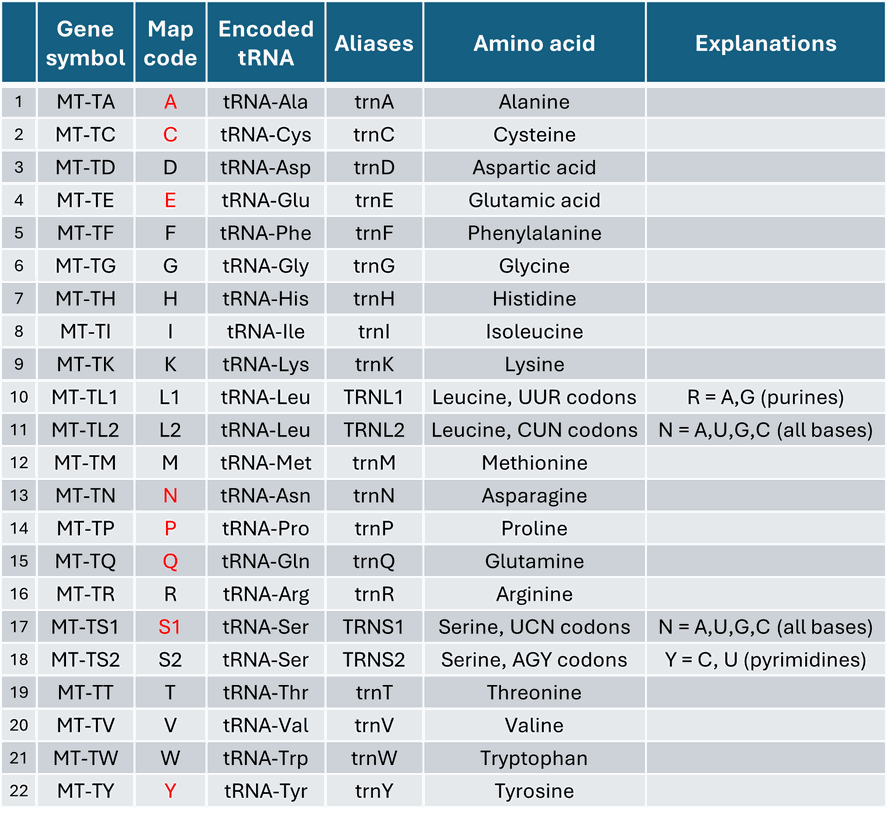
Note that tRNAs are transcribed from the template strand of the respective tRNA genes, not from the coding strand. Therefore, the coding strand (sense strand) has the same sequence as the tRNA (except T in DNA is replaced by U in RNA).
The production of functional (mature) tRNAs from DNA templates is a multi-step procedure that occurs entirely in the mitochondrial matrix and encompasses:
- transcribing both DNA strands via mitochondrial RNA polymerase (POLRMT)
- cleaving polycistronic transcripts via RNase P (mitochondrial form) [cleaving the 5’ end] and RNase Z (ELAC2) [cleaving the 3’ end] to release individual pre-tRNAs
- adding 3’ CCA tail to the terminal discriminator nucleotide via tRNA nucleotidyltransferase
- modifying several bases (e.g. taurine-containing modification at wobble position 34; methylations at position 37)
- attaching the respective amino acid to the fully modified tRNA by aminoacylation via nuclear-encoded aminoacyl-tRNA synthetases
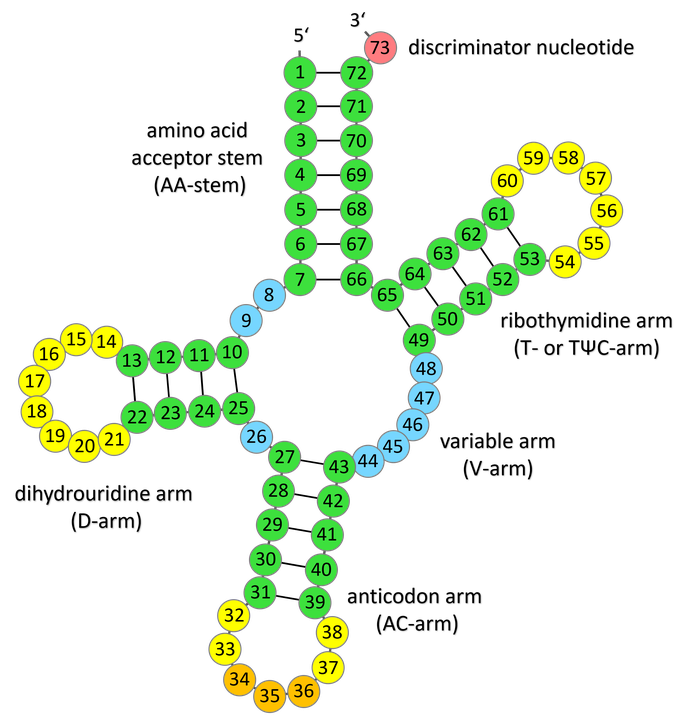
Schematic cloverleaf-like secondary structure of a generalised mitochondrial pre-tRNA. The numbering system follows Sprinzl et al. (1996), except that nucleotides 26 and 44 are not forming part of the stem. (link) Note that in mitochondrial tRNAs, non-canonical G-U base pairings (wobble pairs) are frequently found in the stems, because the mitochondrial translation machinery is adapted to these atypical tRNAs. [G-U pairs form two hydrogen bonds instead of three in G-C pairs, so they are slightly less stable.]
In the following, the secondary structures of all 22 mitochondrial pre-tRNAs in the putative ground pattern of Galliformes are shown. I chose landfowl as an example, because it is the avian order with the oldest crown group (ca. 70 Ma) and because it is lacking the tandem duplication containing additional tRNAs.
Secondary structures of mitochondrial tRNAS have been created with the aid of the online platform R2DT (Sweeney et al., 2025). (link)

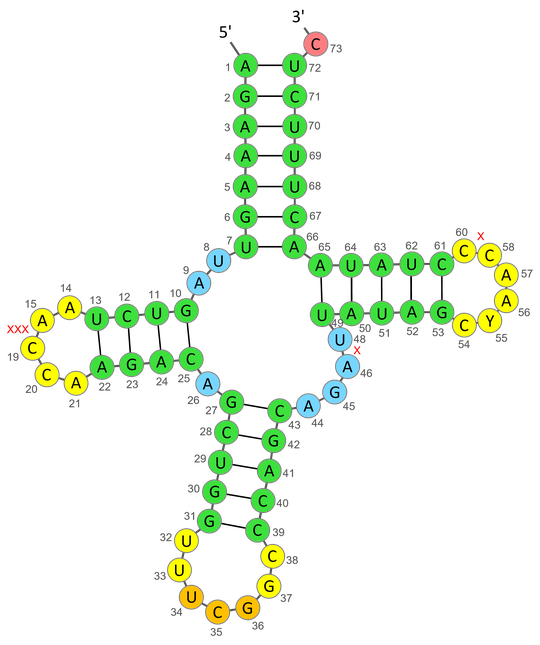
pre-tRNA-Ala
- anticodon: UGC; accepted codons: GCU, GCC, GCA, GCG
- number of nucleotides: 69 (variation within Galliformes: no indels)
- coding strand: (-) strand
- peculiarities: amino acid acceptor stem with 6 bp (instead of 7 bp); probably, a combination of G3:C70 and translocated G4:U69 serves as the major recognition determinant; D-loop with 5 nucleotides (instead of 8 nucleotides)
pre-tRNA-Arg
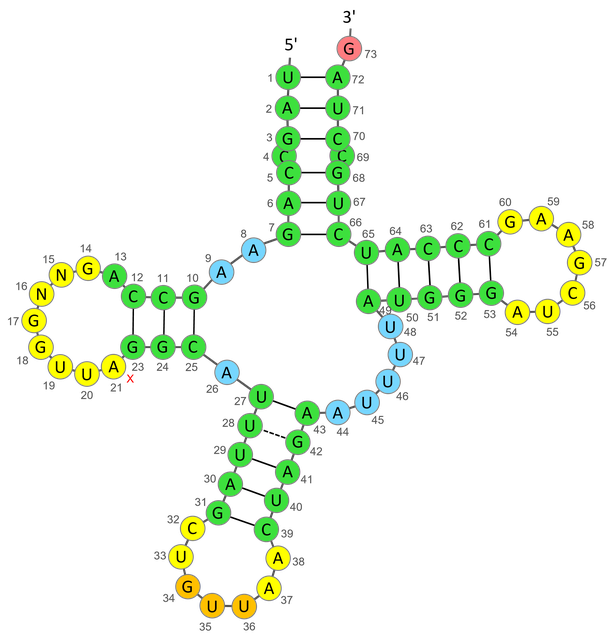
- anticodon: UCG; accepted codons: CGU, CGC, CGA, CGG
- number of nucleotides: 68 (variation within Galliformes: 69 or 70 due to one insertion in D-loop and one insertion in T-loop)
- coding strand: (+) strand
- peculiarities: D-loop with 5 nucleotides (instead of 8 nucleotides); T-loop with 6 nucleotides (instead of 7 nucleotides)
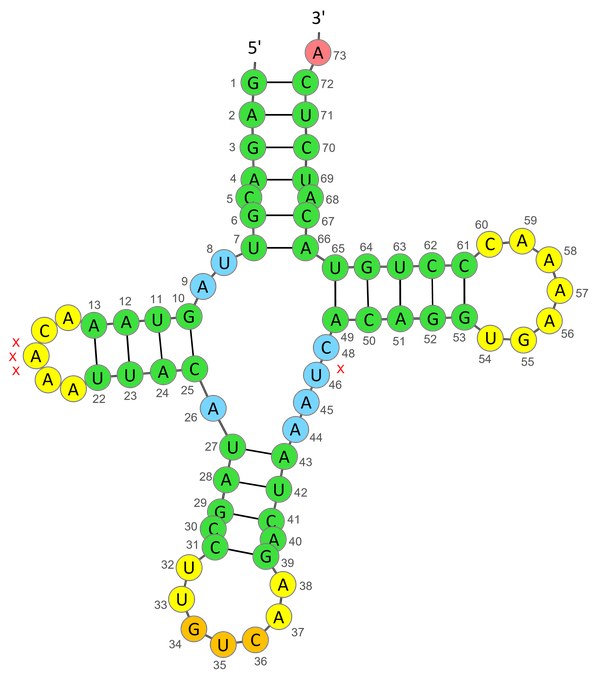
pre-tRNA-Asn
- anticodon: GUU; accepted codons: AAU, AAC
- number of nucleotides: 72 (variation within Galliformes: or 73 due to 1 nucleotide insertion between D-loop and D-stem)
- coding strand: (-) strand
- peculiarities: amino acid acceptor stem with one base pair mismatch; D-stem with 3 bp (instead of 4 bp due to one nucleotide deletion); variable loop with 5 nucleotides
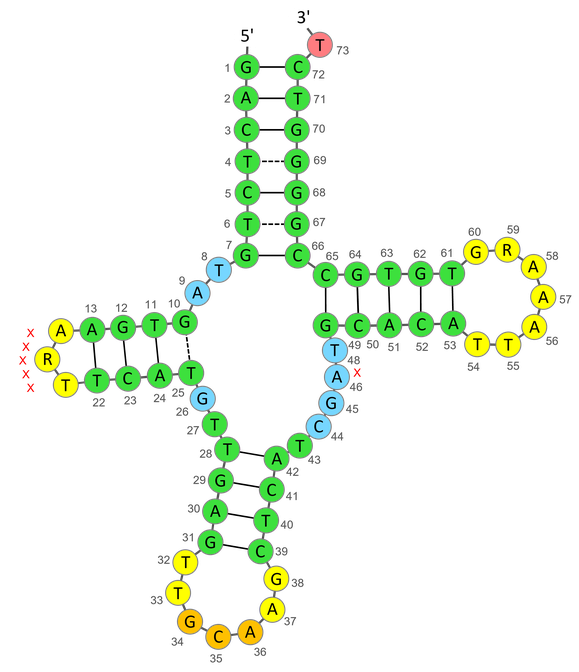
pre-tRNA-Asp
- anticodon: GUC; accepted codons: GAU, GAC
- number of nucleotides: 69 (variation within Galliformes: no indels)
- coding strand: (+) strand
- peculiarities: D-loop with 5 nucleotides (instead of 8 nucleotides); amino acid acceptor stem and anticodon stem with base pair mismatches
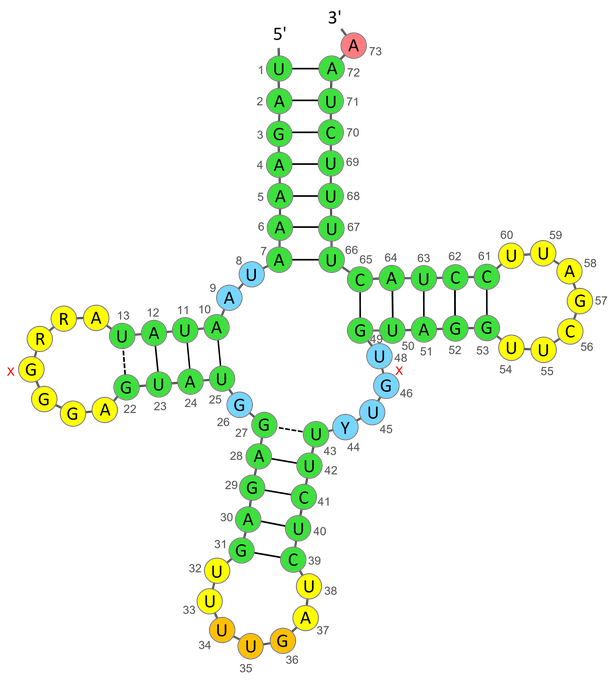
pre-tRNA-Cys
- anticodon: GCA; accepted codons: UGU, UGC
- number of nucleotides: 67 (variation within Galliformes: from 66 to 68 due to one deletion in T-loop and one insertion in 5' acceptor stem)
- coding strand: (-) strand
- peculiarities: D-loop with 3 nucleotides (instead of 8 nucleotides); anticodon stem with 4 bp (instead of 5 bp)
pre-tRNA-Gln
- anticodon: UUG; accepted codons: CAA, CAG
- number of nucleotides: 71 (variation within Galliformes: no indels)
- coding strand: (-) strand
- peculiarities: D-loop with 7 nucleotides (instead of 8 nucleotides)

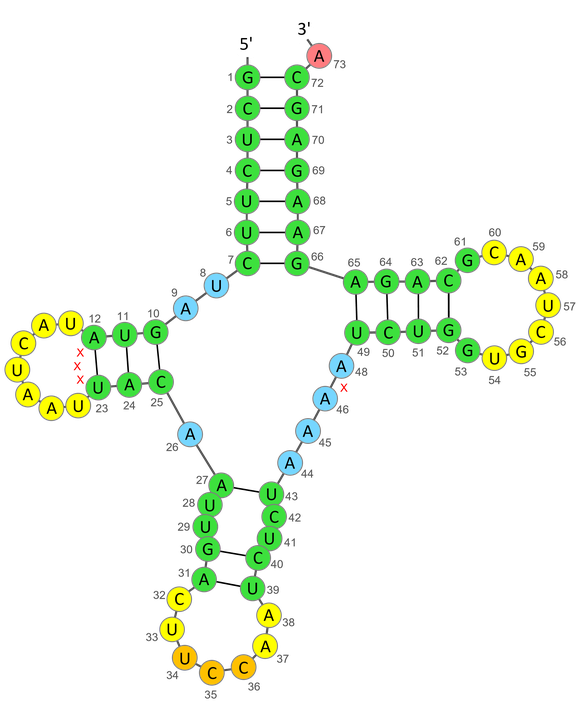
pre-tRNA-Glu
- anticodon: UUC; accepted codons: GAA, GAG
- number of nucleotides: 68 (variation within Galliformes: sometimes 69 due to one insertion in T-stem)
- coding strand: (-) strand
- peculiarities: D-loop with 4 nucleotides (instead of 8 nucleotides)
pre-tRNA-Gly
- anticodon: UCC; accepted codons: GGU, GGC, GGA, GGG
- number of nucleotides: 69 (variation within Galliformes: sometimes 70 due to one insertion in T-loop)
- coding strand: (+) strand
- peculiarities: D-stem with 3 bp (instead of 4 bp); D-loop with 7 nucleotides (instead of 8 nucleotides); anticodon stem with two adjacent base pair mismatches; T-stem with 4 bp (instead of 5 bp)
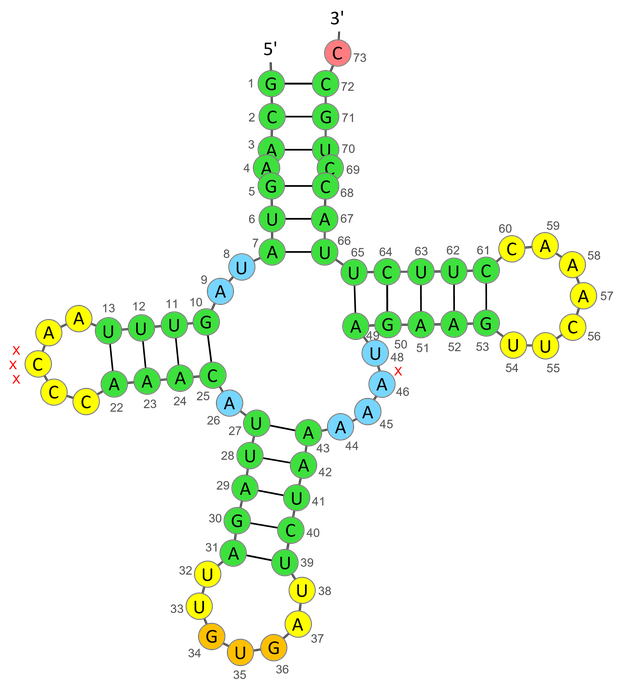
pre-tRNA-His
- anticodon: GUG; accepted codons: CAU, CAC
- number of nucleotides: 69 (variation within Galliformes: sometimes 70 due to one insertion in D-loop)
- coding strand: (+) strand
- peculiarities: one base pair mismatch in amino acid acceptor stem
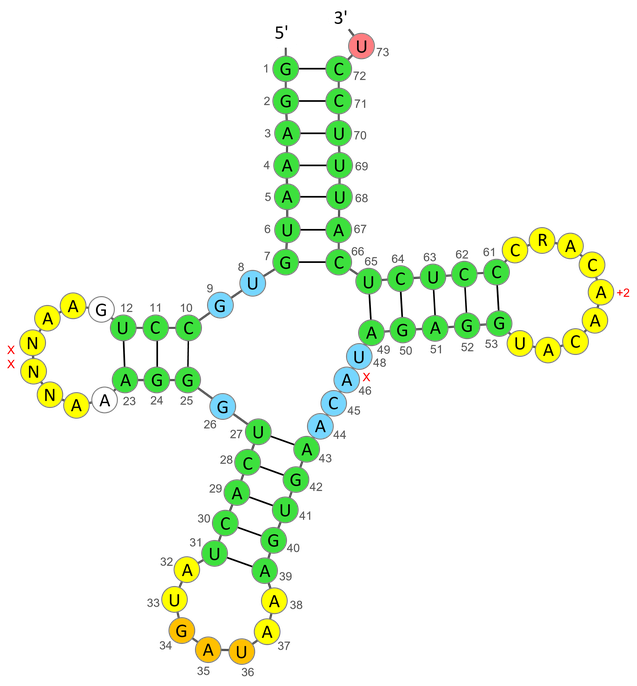
pre-tRNA-Ile
- anticodon: GAU; accepted codons: AUU, AUC
- number of nucleotides: 72 (variation within Galliformes: from 70 to 73 nucleotides due to one or two deletions and one insertion in D-loop)
- coding strand: (+) strand
- peculiarities: D-stem with 3 bp (instead of 4 bp); T-loop with 9 nucleotides (instead of 7 nucleotides)

pre-tRNA-Leu CUN
- anticodon: UAG; accepted codons: CUU, CUC, CUA, CUG
- number of nucleotides: 71 (variation within Galliformes: no indels)
- coding strand: (+) strand
- peculiarities: D-loop with 7 nucleotides (instead of 8 nucleotides)
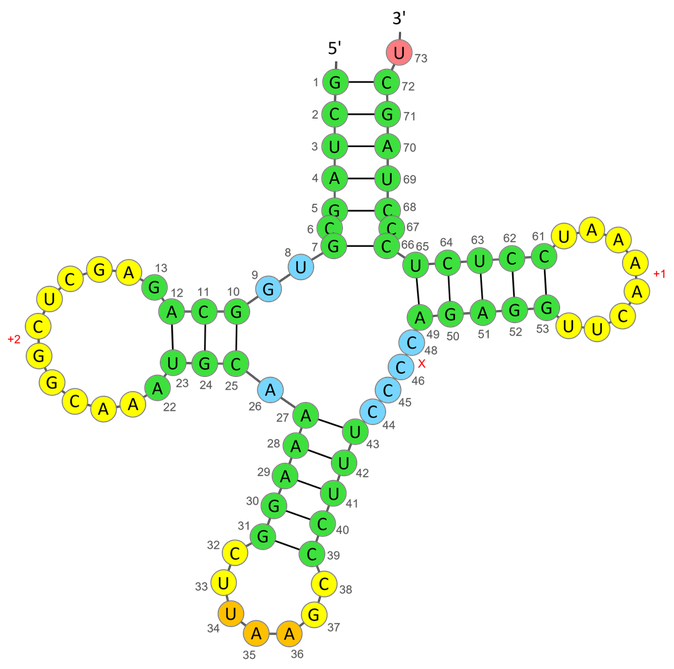
pre-tRNA-Leu UUR
- anticodon: UAA; accepted codons: UUA, UUG
- number of nucleotides: 75 (variation within Galliformes: sometimes 76 due to one insertion in variable arm)
- coding strand: (+) strand
- peculiarities: one base pair mismatch in amino acid acceptor stem; two insertions in D-loop
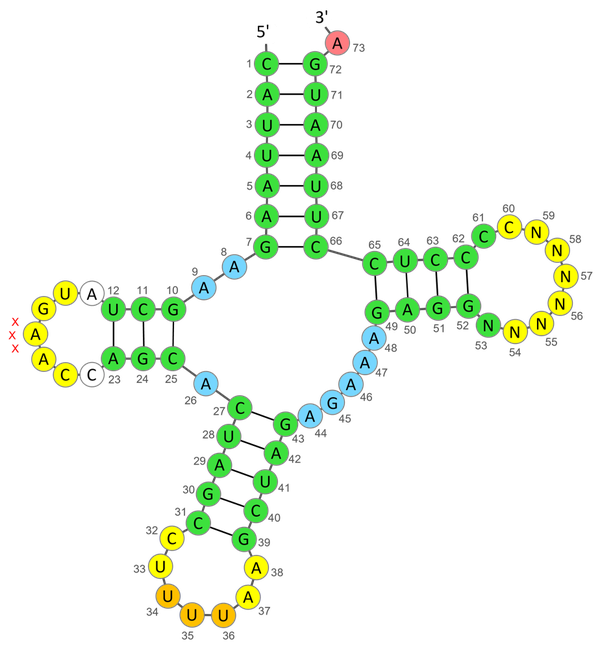
pre-tRNA-Lys
- anticodon: UUU; accepted codons: AAA, AAG
- number of nucleotides: 70 (variation within Galliformes: from 66-72 due to 1 nucleotide insertion in D-loop and 2 nucleotides insertion and 5 nucleotides deletion in T-loop)
- coding strand: (+) strand
- peculiarities: D-stem with 3 bp (instead of 4 bp); D-loop with 5/7 nucleotides (instead of 7/9); variable arm with 5 nucleotides (instead of 4 nucleotides); T-arm highly variable
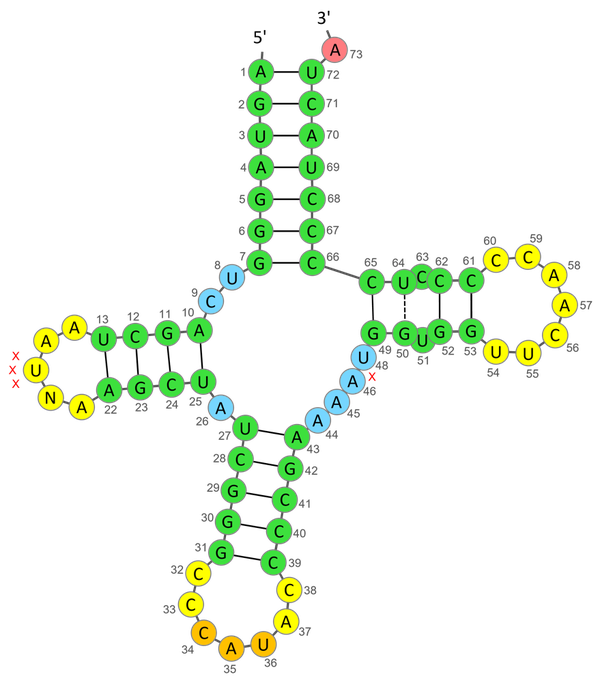
pre-tRNA-Met
- anticodon: CAU; accepted codons: AUG, AUA
- number of nucleotides: 69 (variation within Galliformes: from 68 nucleotides due to deletion in T-stem to 70 nucleotides due to insertion in D-loop)
- coding strand: (+) strand
- peculiarities: D-loop with 5 nucleotides (instead of 8nucleotides); T-stem with one base pair mismatch
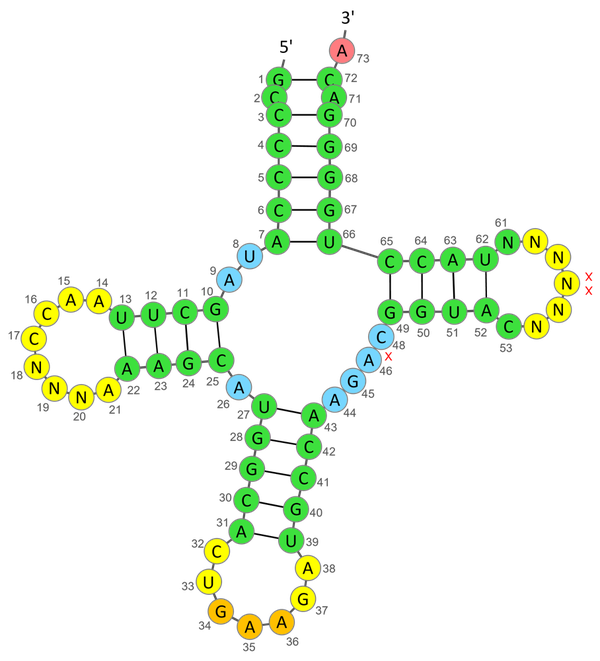
pre-tRNA-Phe
- anticodon: GAA; accepted codons: UUU, UUC
- number of nucleotides: 71 (variation within Galliformes: highly variable, from 68 to 73 nucleotides)
- coding strand: (+) strand
- peculiarities: one base pair mismatch in amino acid acceptor stem; D-loop and T-loop highly variable with numerous indels; homologisation of positions difficult
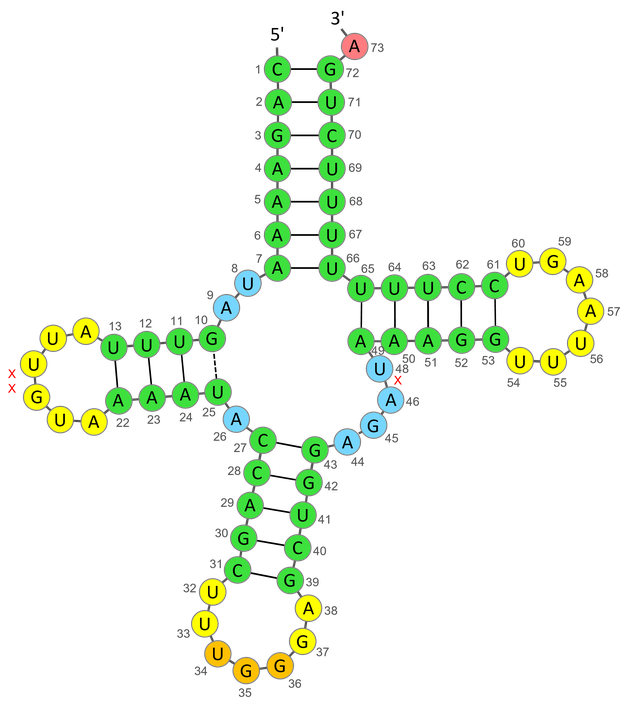
pre-tRNA-Pro
- anticodon: UGG; accepted codons: CCU, CCC, CCA, CCG
- number of nucleotides: 70 (variation within Galliformes: no indels)
- coding strand: (-) strand
- peculiarities: D-loop with 6 nucleotides (instead of 8 nucleotides)
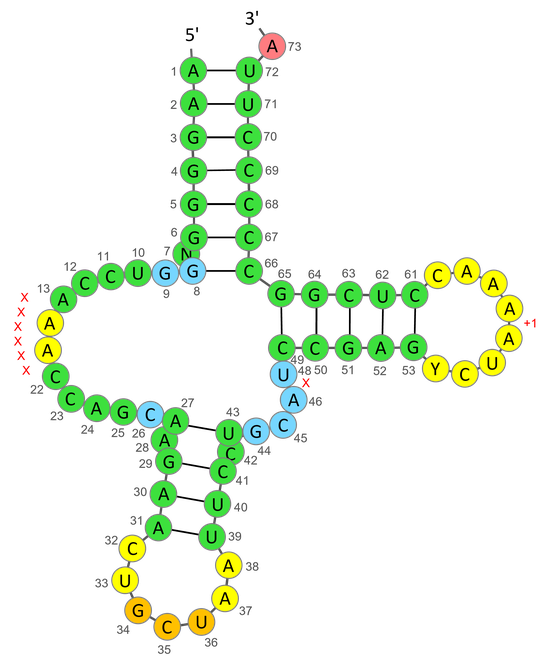
pre-tRNA-Ser AGY
- anticodon: GCU; accepted codons: AGU, AGC
- number of nucleotides: 67 (variation within Galliformes: from 66 to 69 nucleotides due to one deletion and two insertions in D-arm)
- coding strand: (+) strand
- peculiarities: one unpaired nucleotide in amino acid acceptor stem; D-arm without stem-loop structure (an ancient metazoan apomorphy); anticodon stem with one mismatch; T-loop with 8 nucleotides (instead of 7 nucleotides)
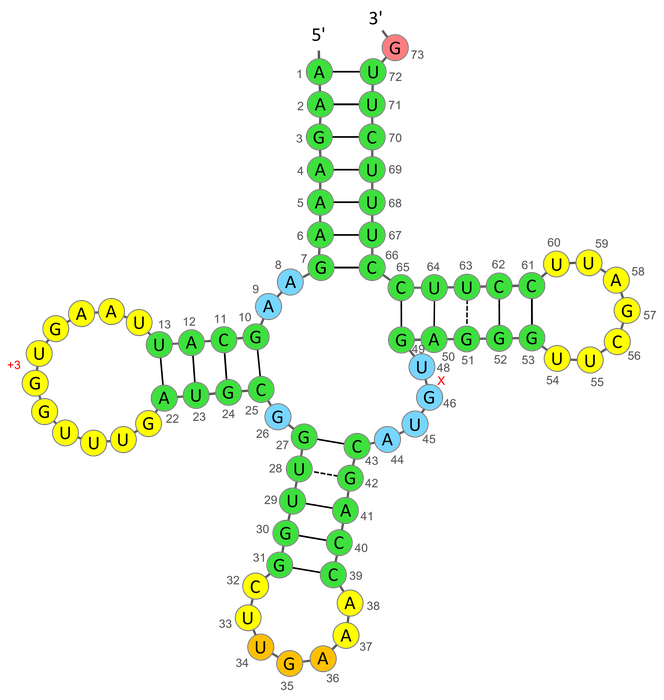
pre-tRNA-Ser UCN
- anticodon: UGA; accepted codons: UCU, UCC, UCA, UCG
- number of nucleotides: 75 (variation within Galliformes: no indels)
- coding strand: (-) strand
- peculiarities: D-loop with 11 nucleotides (instead of 8 nucleotides)
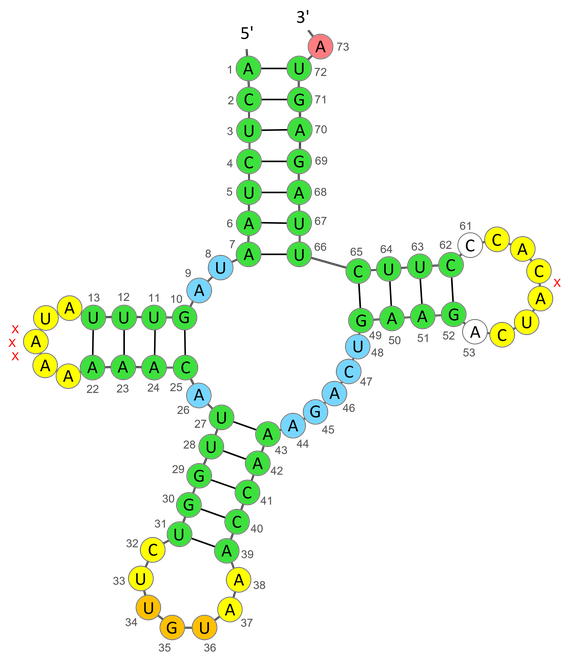
pre-tRNA-Thr
- anticodon: UGU; accepted codons: ACU, ACC, ACA, ACG
- number of nucleotides: 69 (variation within Galliformes: sometimes 70 nucleotides due to one insertion in either D-loop or T-loop)
- coding strand: (+) strand
- peculiarities: D-loop with 5 nucleotides (instead of 8 nucleotides); variable arm with 5 nucleotides; T-stem with 4 bp (instead of 5 bp); T-loop with 8 nucleotides (instead of 7 nucleotides)
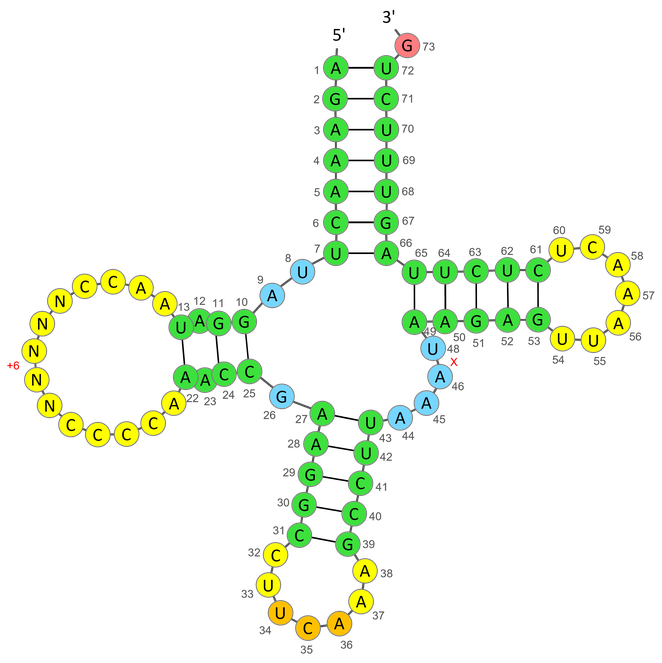
pre-tRNA-Trp
- anticodon: UCA; accepted codons: UGA, UGG
- number of nucleotides: 78 (variation within Galliformes: from 76 to 79 nucleotides due to up to three deletions and one insertion in T-loop)
- coding strand: (+) strand
- peculiarities: T-stem with one mismatch; T-loop with 14 nucleotides (instead of 8 nucleotides)
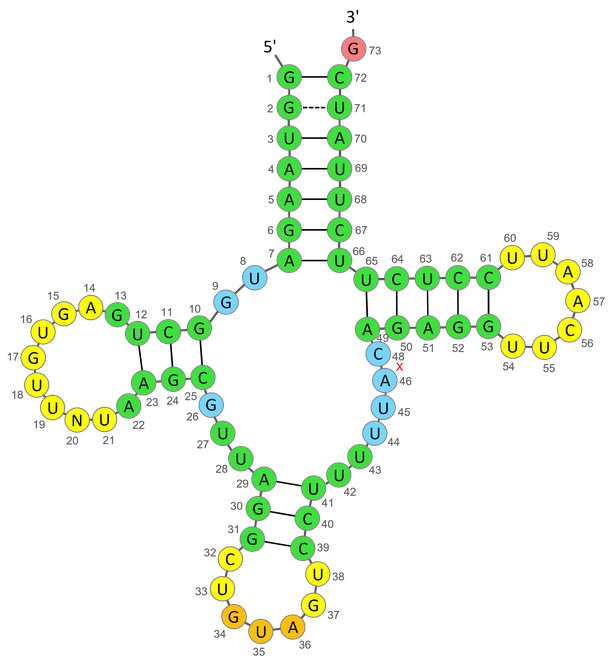
pre-tRNA-Tyr
- anticodon: GUA; accepted codons: UAU, UAC
- number of nucleotides: 72 (variation within Galliformes: 71 due to to deletion of nucleotide T/U18 or T/U19 in D-loop)
- coding strand: (-) strand
- peculiarities: D-stem with 3 bp (instead of 4 bp); anticodon stem with 3 bp (instead of 5 bp)
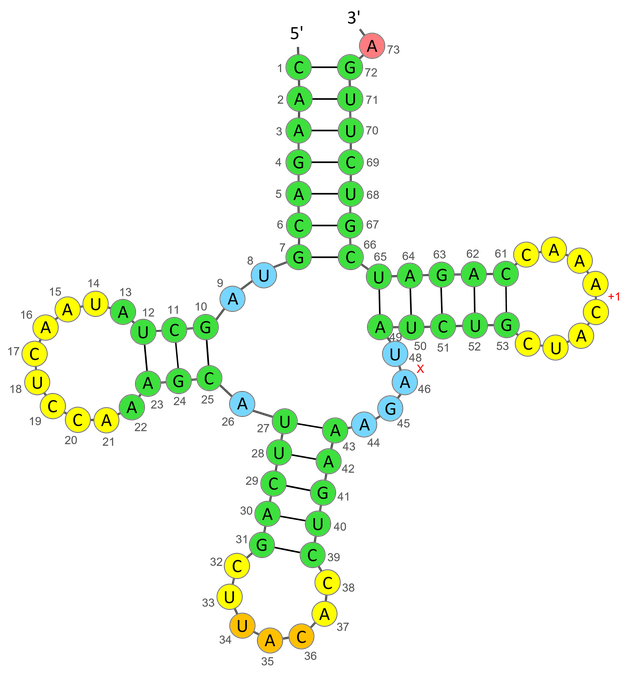
pre-tRNA-Val
- anticodon: UAC; accepted codons: GUU, GUC, GUA, GUG
- number of nucleotides: 73 (variation within Galliformes: between 70 and 74 nucleotides due one insertion and up to two deletions in D-loop and one insertion and up to three deletions in T-loop)
- coding strand: (+) strand
- peculiarities: T-loop with 8 nucleotides (instead of 7 nucleotides)
References
Bai G, Yuan Q, Guo Q, and Duan Y (2023), Identification and phylogenetic analysis in Pterorhinus chinensis (Aves, Passeriformes, Leiothrichidae) based on complete mitogenome, ZooKeys 1172, 15-30. (pdf)
Berg MD, and Brandl CJ (2021), Transfer RNAs: diversity in form and function, RNA Biol. 18, 316-339 (free pdf)
Chen H, Chen Y, Wang Z, Wu D, Chen P, and Chen Y (2024), The complete mitochondrial genome of the Siberian Scoter Melanitta stejnegeri and its phylogenetic relationship in Anseriformes, Int. J. Mol. Sci. 25, e:10181. (free pdf)
Chen P, Han Y, Zhu C, Gao B, and Ruan L (2017), Complete mitochondrial genome of Porzana fusca and Porzana pusilla and phylogenetic relationship of 16 Rallidae species, Genetica 145, 559-573. (abstract)
Chen P, Li J, Li H, Lu Q, Liu W, and Zhang J (2022), Characterization of the complete mitochondrial genome of sea duck Mergus serratus and comparison with other Anseriformes species, Pak. J. Zool. 55, 2365-76. (free pdf)
Giegé R, Jühling F, Pütz J, Stadler P, Sauter C, and Florentz C (2011), Structure of transfer RNAs: similarity and variability, WIREs RNA 3, 37-61. (abstract)
Guo ZL, Zhang Y, Yang H, Wang TS, Wang WW, Zeng SS, Guo Y, Ye L, Du A, Wang ZW, Zeng SM, Tuan J, and Wang L (2022), Sequencing and structural characteristic analysis of mitochondrial genome in Zhijin White Goose (Anser cygnoides), Res. Square (pdf)
Han S, Ding H, Peng H, Dai C, Zhang S, Yang J, Gao J, and Kan X (2024) Sturnidae sensu lato mitogenomics: novel insights into codon aversion, selection, and phylogeny, Animals 14, e:2777. (free pdf)
Harrison GL, McLenachan PA, Phillips MJ, Slack KE, Cooper A, and Penny D (2004), Four new avian mitochondrial genomes help get to basic evolutionary questions in the Late Cretaceous, Mol. Biol. Evol. 21, 974-983. (pdf)
Hou R, Zhang Q, Duan M, Tang S, Liu S, Jiang D, Du C, and Yang X (2025), Characterization of the complete mitochondrial genome of Monticola rufiventris and phylogenetic implications, Sci. Rep. 15, e:18449. (free pdf)
Jühling F, Mörl M, Hartmann RK, Sprinzl M, Stadler PF, and Pütz J (2009), tRNAdb 2009: compilation of tRNA sequences and tRNA genes, Nucl. Acids Res. 37, D159-D162. (free pdf)
Kan XZ, Li XF, Lei ZP, Wang M, Chen L, Gao H, and Yang ZY (2010), Complete mitochondrial genome of Cabot´s tragopan, Tragopan caboti (Galliformes: Phasianidae), Gen. Mol. Res. 9, 1204-16. (pdf)
Kumazawa Y, and Nishida M (1993), Sequence evolution of mitochondrial tRNA genes and deep-branch animal phylogenetics, J. Mol. Evol. 37, 380-398. (abstract)
Kumazawa Y, and Nishida M (1995), Variations in mitochondrial tRNA gene organization of reptiles as phylogenetic markers, Mol. Biol. Evol. 12, 759-772. (free pdf)
Liu D, Zhou Y, Fei Y, Xie C, and Kou S (2021), Mitochondrial genome of the critically endangered Baer‘s Pochard, Aythya baeri, and its phylogenetic relationship with other Anatidae species, Sci. Rep. 11, e:24302. (pdf)
Liu HY, Sun CH, Zhu Y, and Zhang QZ (2020), Complete mitogenomic and phylogenetic characteristics of the speckled wood-pigeon (Columba hodgsonii), Mol. Biol. Rep. 47, 3567-76. (abstract)
Mei Q, Deng Y, Zhao D, Jiang D, Liao Y, Yu X, Liu P, and Jiang L (2024), Characterization of the complete mitogenome of the Ring-necked Pheasant Phasianus colchicus (Galliformes: Phasianidae) and systematic implications for Phasianinae phylogenetics, Genes 15, e:1569. (free pdf)
Nagarajan M, Kamalakkannan R, Prabhu V, Bhavana K, Gopalakrishnan A, Thomas S, Chaithanya Suresh A, Puzhakkal A, Meghana G, Suseela Ramankutty A, and Mustak MS (2024), Mitochondrial genome of the Indian spot-billed duck and its phylogenetic and conservation implications, Sci. Rep. 14, e:24572. (free pdf)
Sajek MP, Woźniak T, Sprinzl M, Jaruzelska J, and Barciszewski J (2020), T-psi-C: user friendly database of tRNA sequences and structures, Nucl. Acids Res. 48, D256-D260. (free pdf)
Seutin G, Lang BF, Mindell DP, and Morais R (1994), Evolution of the WANCY region in amniote mitochondrial DNA, Mol. Biol. Evol. 11, 329-340. (free pdf)
Sprinzl M, Dank N, Nock S, and Schön A (1991), Compilation of tRNA sequences and sequences of tRNA genes, Nucl. Acids Res. 19, 2127-71. (free pdf)
Sprinzl M, Steegborn C, Hübel F, and Steinberg S (1996), Compilation of tRNA sequences and sequences of tRNA genes, Nucl. Acids Res. 24, 68-72. (free pdf)
Sprinzl M, Horn C, Brown M, Ioudovitch A, and Steinberg S (1998), Compilation of tRNA sequences and sequences of tRNA genes, Nucl. Acids Res. 26, 148-153. (free pdf)
Sprinzl M, and Vassilenko KS (2005), Compilation of tRNA sequences and sequences of tRNA genes, Nucl. Acids Res. 33, D139-D140. (free pdf)
Steinberg S, Misch A, and Sprinzl M (1993), Compilation of tRNA sequences and sequences of tRNA genes, Nucl. Acids Res. 21, 3011-15. (free pdf)
Sun G, Zhao C, Xia T, Wei Q, Yang X, Feng S, Sha W, and Zhang H (2020), Sequence and organisation of the mitochondrial genome of Japanese Grosbeak (Eophona personata), and the phylogenetic relationships of Fringillidae, ZooKeys 955, 67-80. (free pdf)
Sweeney BA, Hoksza D, Nawrocki EP, Ribas CE, Madeira F, Cannone JJ, Gutell R, Maddala A, Meade CD, Williams LD, Petrov AS, Chan PP, Lowe TM, Finn RD, and Petrov AI (2021), R2DF is a framework for predicting and visualising RNA secondary structure using templates, Nat. Commun. 12, e:3494. (free pdf)
Tamaki S, Tomita M, Suzuki H, and Kanai A (2018), Systematic analysis of the binding surfaces between tRNAs and their respective aminoacyl tRNA synthetase based on structural and evolutionary data, Front. Genet. 8, e:227. (free pdf)
Valverde JR, Marco R, and Garesse R (1994), A conserved heptamer motif for ribosomal RNA transcription termination in animal mitochondria, Proc. Natl. Acad. Sci. USA 91, 5368-71. (pdf)
Varani G, and McClain WH (2000), The G•U wobble base pair, EMBO Rep. 1, 18-23. (free pdf)
Watanabe Y, Suematsu T, and Ohtsuki T (2014), Losing the stem-loop structure from metazoan tRNAs and co-evolution of interacting factors, Front. Genet. 5, e:109. (free pdf)
Yang C, Du X, Liu Y, Yuan H, Wang Q, Hou X, Gong H, Wang Y, Huang Y, Li C, and Ye H (2022), Comparative mitogenomics of the genus Motacilla (Aves, Passeriformes) and its phylogenetic implications, ZooKeys 1109, 49-65. (free pdf)
Xia L, Bi S, Zhang Y, Chen C, and Chen N (2025), Molecular characterization and phylogenetic analyses of the mitogenome of the Wan-Xi white goose, a native goose breed in China, BMC Genomic Data 26, e:34. (free pdf)
Xu N, Ding J, Que Z, Xu W, Ye W, and Liu H (2021), The mitochondrial genome and phylogenetic characteristics of the Thick-billed Green-Pigeon, Treron curvirostra: the first sequence for the genus, ZooKeys 1041, 167-182. (free pdf)
Zeng QY, Peng GX, Li G, Zhou JB, Zheng WQ, Xue MQ, Wang ED, and Zhou XL (2019), The G3–U70-independent tRNA recognition by human mitochondrial alanyl-tRNA synthetase, Nucl. Acids Res. 47, 3072-85. (free reading)
Zhao Z, Alimo Z, Zhao X, Qin H, Dayananda B, Jiang L, and Chen W (2022), Complete mitochondrial genome of Turdus merula (Aves: Passeriformes: Turdidae) and related species: genome characteristics and phylogenetic relationships, Pak. J. Zool. 2022, 1-17. (pdf)
Zhong Y, Zhou M, Ouyang B, Zeng C, Zhang M, and Yang J (2020), Complete mtDNA genome of Otus sunia (Aves, Strigidae) and the relaxation of selective constraints on Strigiformes mtDNA following evolution, Genomics 112, 3815-25. (free viewing)