
Acrocephalidae (Reed Warblers and Allies)
- Phylogenetic placement: Passeri: Passerides: Sylviida: Locustelloidea
- Distribution: Old World and Australia, absent in the Americas and New Zealand
- Number of extant genera: 7
- Number of extant and recently extinct species: 61
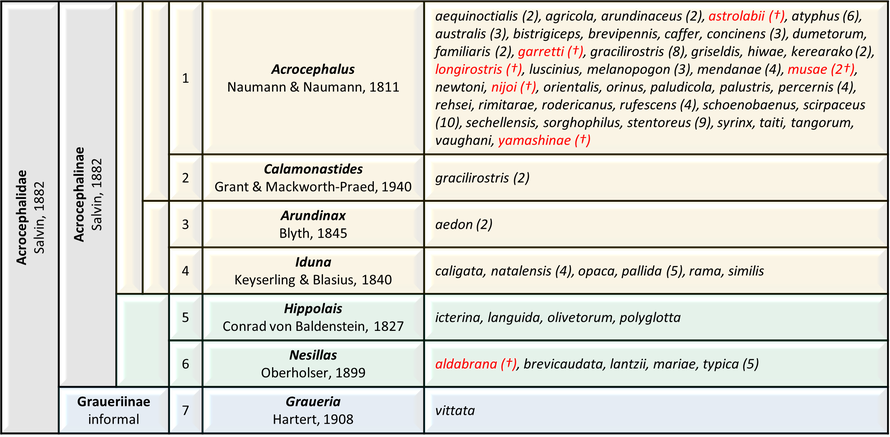
Traditional genus-level classification of extant and recently extinct (red letters) Acrocephalidae following the AviList checklist v2025. (link) The number of subspecies is given in parentheses. The phylogenetic arrangement is based on a combination of Moreno Fernández (2024) and Oliveros et al. (2019) and differs from the topology of the BOW Phylogeny Explorer tree v1.6. (link)
References [annotated]
Alström P, Olsson U, and Lei F (2013), A review of the recent advances in the systematics of the avian superfamily Sylioidea, Avian Res 4, 99-131. (free pdf) [note: included Acrocephalus, Calamonastides, Hippolais, and Nesillas]
Arbabi T, Gonzalez J, and Wink M (2014), A re-evaluation of phylogenetic relationships within
reed warblers (Aves: Acrocephalidae) based on eight molecular loci and ISSR profiles, Mol. Phylogenet. Evol. 78, 304-313. (abstract) [note: shifted aedon from Iduna to Phragamaticola, now
in Arundinax]
Barker FK, Barrowclough GF, and Groth JG (2002), A phylogenetic hypothesis for passerine birds: taxonomic and biogeographic implications of an analysis of nuclear DNA sequence data, Proc. R. Soc. B 269, 295-308 (abstract)
Cibois A, Beadel JS, Graves GR, Pasquet E, Slikas B, Sonsthagen SA, Thibault JC, and Fleischer RC (2011), Charting the course of reed-warblers across the Pacific islands, J. Biogeogr. 38, 1963-75. (abstract) [focal taxa: several Acrocephalus species]
Fregin S, Haase M, Olsson U, and Alström P (2009), Multi-locus phylogeny of the family Acrocephalidae (Aves: Passeriformes) – The traditional taxonomy overthrown, Mol. Phylogenet. Evol. 52, 866-878. (abstract) [Note: focal taxa: Acrocephalus, Hippolais, and Chloropeta, with the latter genus later being split into Calamonastides and Iduna]
Fuchs J, Lemoine D, Parra JL, Pons JM, Raherilalao MJ, Prys-Jones R, Thebaud C, Warren BH, and Goodman SM (2016), Long-distance dispersal and inter-island colonization across the western Malagasy Region explain diversification in brush-warblers (Passeriformes: Nesillas), Biol. J. Linn. Soc. 119, 873-889. (abstract)
Moreno Fernández SE (2024), Lineage diversification of Acrocephalidae family (Reed Warblers) and its relationship with migratory behaviour and islands colonisation, PhD thesis, University of Porto, Portugal. (free pdf) [note: treated all genera except Graueria]
Oliveros CH, Field DJ, Ksepka DT, Barker KF, Aleixo A, Andersen MJ, Alström P, Benz BW, Braun EL, Braun MJ, Bravo GA, Brumfield RT, Chesser RT, Claramunt S, Cracraft J, Cuervo AM, Derryberry EP, Glenn TC, Harvey MG, Hosner PA, Joseph L, Kimball RT, Mack AL, Miskelly CM, Peterson AT, Robbins MB, Sheldon FH, Silveira LF, Smith BT, White ND, Moyle RG, and Faircloth BC (2019), Earth history and the passerine superradiation, Proc. Natl. Acad. Sci. U.S.A. 116, 7915-25. (pdf) [note: included Acrocephalus orientalis, Graueria vittata and Nesillas typica]
Stiller J, Feng S, Chowdhury AA, Rivas-González I, Duchêne DA, Fang Q, Deng Y, Kozlov A, Stamatakis A, Claramunt S, Nguyen JMT, Ho SYW, Faircloth BC, Haag J, Houde P, Cracraft J, Balaban M, Mai U, Chen G, Gao R, Zhou C, Xie Y, Huang Z, Cao Z, Yan Z, Ogilvie HA, Nakhleh L, Lindow B, Morel B, Fjeldså J, Hosner PA, da Fonseca RR, Petersen B, Tobias JA, Székely T, Kennedy JD, Reeve AH, Liker A, Stervander M, Antunes A, Tietze DT, Bertelsen M, Lei F, Rahbek C, Graves GR, Schierup MH, Warnow T, Braun EL, Gilbert MTP, Jarvis ED, Mirarab S, and Zhang G (2024), Complexity of avian evolution revealed by family-level genomes, Nature 629, 851-860. (pdf) [note: included Acrocephalus arundinaceus and Hippolais icterina]