
Cardinalidae (Cardinals and Allies)
- Phylogenetic placement: Passeri: Passerides: Passerida: Emberizoidea
- Distribution: New World
- Number of extant genera: 14
- Number of extant species: 52
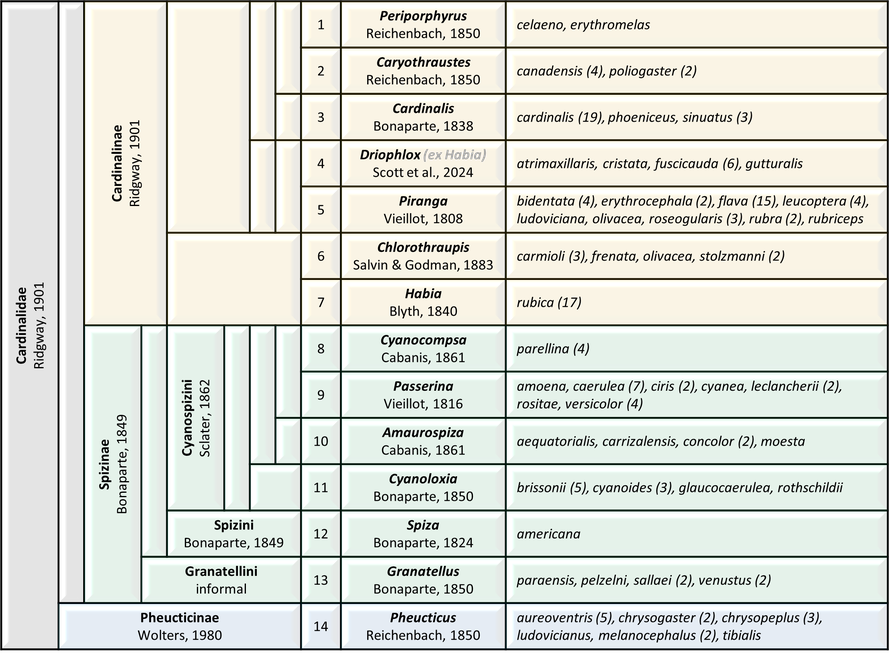
Traditional genus-level classification of extant Cardinalidae following the AviList checklist v2025. (link) The number of subspecies is given in parentheses. The phylogenetic arrangement is based on Scott (2022), and largely matches that of the BOW Phylogeny Explorer tree v1.6 except for the relationships within the Cyanospizini and the position of Driophlox. (link) Note that Amaurospiza concolor, Chlorothraupis carmioli, Pheucticus aureoventris and P. chrysopeplus proved to be non-monophyletic (Scott, 2022). Also note that Piranga rubra cannot be divided into two subspecies (Shepherd & Burns, 2007).
References [annotated]
Areta JI, Benítez Saldívar MJ, Lentino M, Miranda J, Ferreira M, Klicka J, and Pérez-Emán J (2023), Phylogenetic relationships and systematics of the bamboo-specialist Amaurospiza blue seed-eaters, Ibis 165, 844-861. (abstract) [note: recognised four species in Amaurospiza]
Barker FK, Burns KJ, Klicka J, Lanyon SM, and Lovette IJ (2013), Going to extremes: contrasting rates of diversification in a recent radiation of New World passerine birds, Syst. Biol. 62, 298-320. (abstract). [note: provided a phylogeny of all cardinalid genera in Fig. 6]
Barker FK, Burns KJ, Klicka J, Lanyon SM, and Lanyon IJ (2015), New insights into New World biogeography: An integrated view from the phylogeny of blackbirds, cardinals, sparrows, tanagers, warblers, and allies, Auk 132, 333-348. (free pdf) [note: provided a phylogeny of all genera and most species; found Cyanocompsa to be non-monophyletic; found Driophlox (still as Habia) to be sister group to Habia rubica + Chlorothraupis]
Bryson RW, Chaves J, Smith BT, Miller MJ, Winker K, Pérez-Emán JL, and Klicka J (2014), Diversification across the New World within the ‘blue‘ cardinalids (Aves: Cardinalidae), J. Biogeogr. 41, 587-599. (free pdf) [note: provided a timetree of all species of blue cardinalids, tribe Cyanospizini, with the following topology: ((Cyanocompsa + Passerina) + (Amaurospiza + Cyanoloxia)); recognised two new species by elevating Amaurospiza aequatorialis and Cyanocompsa rothschildii from subspecies to species status; transferred both Cyanocompsa brissonii and C. cyanoides to Cyanoloxia]
Campillo LC, Burns KJ, Moyle RG, and Manthey JD (2019), Mitochondrial genomes of the bird genus Piranga: rates of sequence evolution, and discordance between mitochondrial and nuclear markers, Mitochondrial DNA B 4, 2566-69. (pdf) [note: provided a mitogenome-based phylogeny of all 11 Piranga species, resulting in the same topology as in the nuclear DNA-based phylogeny of Manthey et al., 2016]
Castillo-Chora Vd, Zamudio-Beltrán LE, Pozo C, and Hernández-Baños BE (2021), Phylogeography of Habia fuscicauda (Cardinalidae) indicates population isolation, genetic divergence and demographic changes during the Quaternary climate shifts in the Mesoamerican rainforest, J. Ornithol. 162, 961-976. (abstract) [note: found Driophlox (ex Habia) fuscicauda to consist of two principal clades that diverged at 2.5 Ma]
Klicka J, Johnson KP, and Lanyon SM (2000), New World nine-primaried oscine relationships: constructing a mitochondrial DNA framework, Auk 117, 321-336. (abstract) (pdf) [note: studied three typical cardinalid species and showed that Piranga, traditionally considered a tanager (Thraupidae), is a cardinalid, too]
Klicka J, Fry AJ, Zink RM, and Thompson CW (2001), A cytochrome-b perspective on Passerina bunting relationships, Auk 118, 611-623. (free pdf) [note: found Guiraca caerulea to be nested within the six species of Passerina; thus seven Passerina species were recognised]
Klicka J, Burns K, and Spellman GM (2007), Defining a monophyletic Cardinalini: a molecular perspective, Mol. Phylogenet. Evol. 45, 1014-32. (abstract) (author's pdf) [note: transferred Amaurospiza, Chlorothraupis, Habia, and Piranga from Thraupidae to Cardinalidae; transferred Granatellus from Parulidae to Cardinalidae; excluded Parkerthraustes, Porphyrospiza, Saltator from Cardinalidae (now in Thraupidae); established five primary clades within Cardinalidae]
Lavinia PD, Escalante P, García NC, Barreira AS, Trujillo-Arias N, Tubaro PL, Naoki K, Miyaki CY, Santos FR, and Lijtmaer DA (2015), Continental-scale analysis reveals deep diversification within the polytypic Red-crowned Ant Tanager (Habia rubica, Cardinalidae), Mol. Phylogenet. Evol. 89, 182-193. (abstract) [note: suggested to split H. rubica into three species: rubica, rubra, and rubicoides; compare Ramírez-Barrera et al., 2018, 2019]
Manthey JD, Campillo LC, Burns KJ, and Moyle RG (2016), Comparison of target-capture and restriction-site associated DNA sequencing for phylogenomics: a test in cardinalid tanagers (Aves, genus Piranga), Syst. Biol. 65, 640-650. (free pdf) [note: provided a fully resolved phylogeny of all 11 Piranga species; proposed to lump P. flava, P. hepatica and biphyletic P. lutea]
Porzio NS, Crottini A, Leite RN, and Mota PG (2024), Song determined by phylogeny and body mass in two differently constrained groups of birds: manakins and cardinals, BMC Ecol. Evol. 24, e:109. (pdf) [note: provided a complete species-level cardinalid phylogeny; placed Dryophlox (as Habia) sister-group to Habia rubica + Chlorothraupis; misplaced Chlorothraupis stolzmanni within Cyanocompsa]
Pulgarín-R PC, Tilston Smith B, Bryson RW, Spellman GM, and Klicka J (2013), Multilocus phylogeny and biogeography of the New World Pheucticus grosbeaks (Aves: Cardinalidae), Mol. Phylogenet. Evol. 69, 1222-27. (abstract) [note: provided a timetree of all species and several subspecies of Pheucticus; found P. aureoventris and P. chrysopeplus to be non-monophyletic (see also Scott, 2022)]
Ramírez-Barrera SM, Hernández-Baños BE, Jaramillo-Correa JP, and Klicka J (2018), Deep divergence of Red-crowned Ant Tanager (Habia rubica: Cardinalidae), a multilocus phylogenetic analysis with emphasis in Mesoamerica, PeerJ 6, e:5496. (free pdf) [note: provided a timetree of all 17 subspecies; proposed to distinguish at least seven full species; compare Lavinia et al., 2015]
Scott BF (2022), Phylogenetics of Cardinalidae and the impact of habitat, climate, and ecology on the evolution of color, Master Thesis, San Diego State University, California,168 pp. (free pdf) [note: provided a complete species-level phylogeny; found Habia, Amaurospiza concolor, Chlorothraupis carmioli, and two Pheucticus species (aureoventris and chrysopeplus) to be non-monophyletic]
Scott BF, Chesser RT, Unitt P, and Burns KJ (2024), Driophlox, a new genus of cardinalid (Aves: Passeriformes: Cardinalidae), Zootaxa 5406, 497-500. (no abstract available) (link) [note: reviewed evidence for the non-monophyly of Habia and proposed a new genus name in order to establish monophyletic genera]
Shepherd TM, and Burns KJ (2007), Intraspecific genetic analysis of the summer tanager Piranga rubra: Implications for species limits and conservation, J. Avian Biol. 38, 13-37. (view pdf) [note: provided a phylogeny of all Piranga species, and showed that P. r. rubra is paraphyletic with respect to P. r. cooperi]
Stiller J, Feng S, Chowdhury AA, Rivas-González I, Duchêne DA, Fang Q, Deng Y, Kozlov A, Stamatakis A, Claramunt S, Nguyen JMT, Ho SYW, Faircloth BC, Haag J, Houde P, Cracraft J, Balaban M, Mai U, Chen G, Gao R, Zhou C, Xie Y, Huang Z, Cao Z, Yan Z, Ogilvie HA, Nakhleh L, Lindow B, Morel B, Fjeldså J, Hosner PA, da Fonseca RR, Petersen B, Tobias JA, Székely T, Kennedy JD, Reeve AH, Liker A, Stervander M, Antunes A, Tietze DT, Bertelsen M, Lei F, Rahbek C, Graves GR, Schierup MH, Warnow T, Braun EL, Gilbert MTP, Jarvis ED, Mirarab S, and Zhang G (2024), Complexity of avian evolution revealed by family-level genomes, Nature 629, 851-860. (pdf) [note: timetree of Cardinalis cardinalis, Passerina amoena & Pheucticus melanocephalus]