
Cisticolidae (Cisticolas and Allies)
- Phylogenetic placement: Passeri: Passerides: Sylviida
- Distribution: Africa, Eurasia, Wallacea, Australia
- Number of extant genera: 26
- Number of extant species: 164
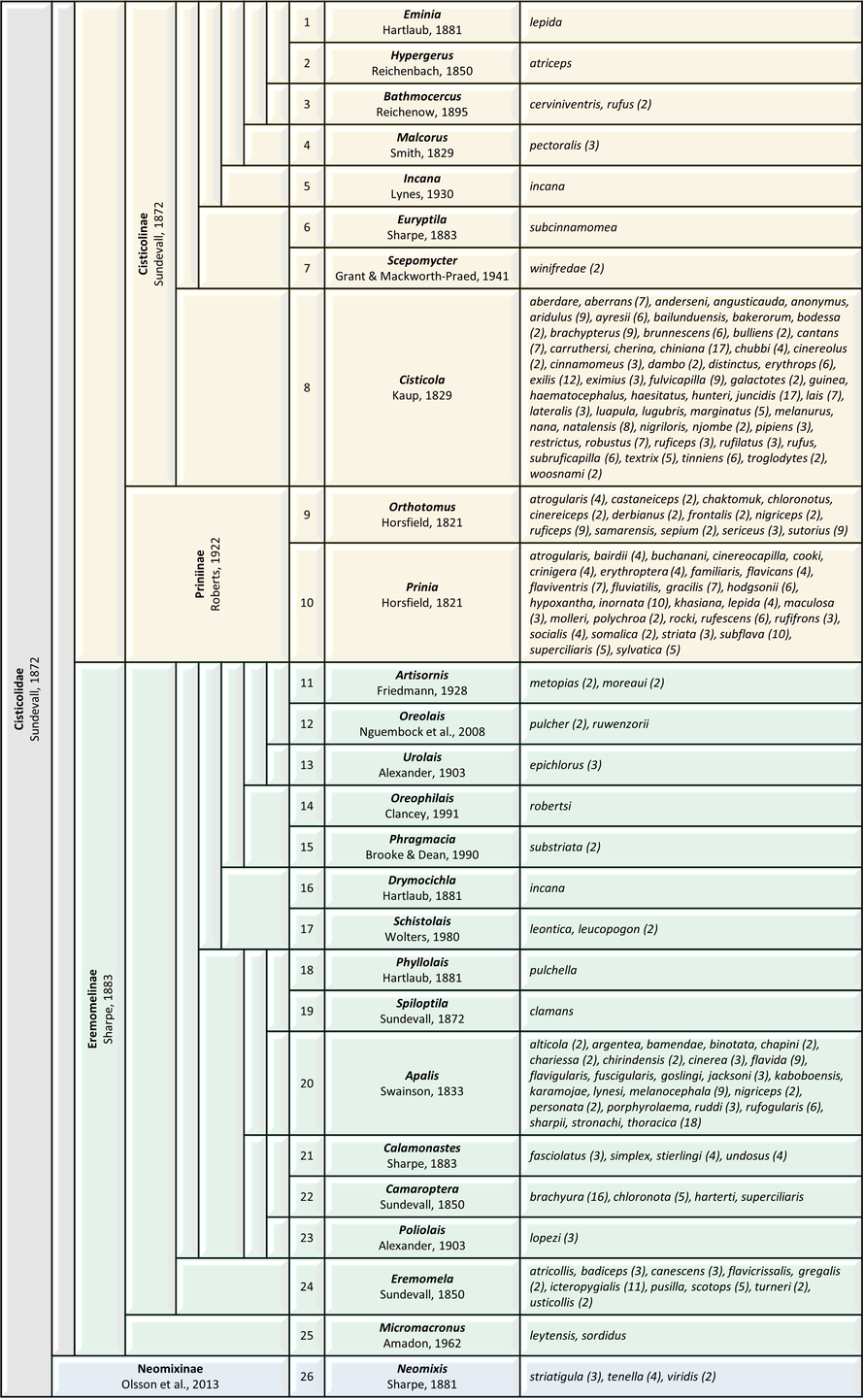
Traditional genus-level classification of extant Cisticolidae following the AviList checklist v2025. (link) The number of subspecies is given in parentheses. The phylogenetic arrangement is based on Olsson et al. (2013) and largely matches that of the BOW Phylogeny Explorer tree v1.6 with the following exceptions: (1) Incana and the clade comprising Euryptila and Scepomycter swapped positions, and (2) Calamonastes and Poliolais are embedded in Camaroptera, and (3) the extended Camaroptera is not considered being sister to Apalis, Phyllolais, and Spiloptila, and (4) Phragmacia is sister to the clade comprising Artisornis and Oreolais instead of being sister to Oreophilais. (link)
Bibliography [annotated]
Alström P, Ericson PGP, Olsson U, and Sundberg P (2006), Phylogeny and classification of the avian superfamily Sylvioidea, Mol. Phylogenet. Evol. 47, 960-973. (abstract) [note: provided a phylogeny of seven cisticolid genera; recovered two principal clades, the first clade comprising Apalis, Camaroptera and Spiloptila, and the second clade comprising Bathmocercus, Cisticola, Orthotomus, and Prinia (including former Heliolais); Neomixis wasn't studied]
Alström P, Rasmussen PC, Sangster G, Dalvi S, Round PD, Zhang R, Yao CT, Irestedt M, Le Manh H, Lei F, and Ilsson U (2019), Multiple species within the Striated Prinia Prinia crinigera – Brown Prinia P. polychroa complex revealed through an integrative taxonomic approach, Ibis 162, 936-967. (abstract) [note: split P. crinigera s.l. into P. crinigera s.str. and P. striata; elevated three Prinia polychroa subspecies (cooki, polychroa, and rocki) to species level; reassigned P. polychroa bangsi to P. crinigera bangsi; provided a phylogeny of the five species based on three genes, placing P. striata sister to the other four species; provided a cyt b-based timetree of eight Prinia species, but with a different tree topology]
Alström P, Rasmussen PC, Xia C, Zhang L, Liu C, Magnusson J, Shafaeipour A, and Olsson U (2021), Morphology, vocalizations, and mitochondrial DNA suggest that the Graceful Prinia is two species, Ornithology 138, e:ukab014. (free pdf) [note: proposed to split Prinia gracilis into two species, P. gracilis and P. lepida]
Beresford P, Barker FK, Ryan PG, and Crowe TM (2005), African endemics span the tree of songbirds (Passeri): molecular systematics of several evolutionary ‘enigmas‘, Proc. R. Soc. Lond. B 272, 849-858. (abstract) [note: provided an undated phylogeny of the cisticolid genera Apalis, Camaroptera, Cisticola, Eminia, Euryptila, Orthotomus, and Prinia]
Bowie RCK, Pasquet E, McEntee JP, Njilima F, and Fjeldså J (2018), The systematics and biogeography of African tailorbirds (Cisticolidae: Artisornis) with comment on the choice of Bayesian branch-length prior when analyzing heterogeneous data, Mol. Phylogenet. Evol. 118, 172-183. (free pdf) [note: provided a timetree of 10 cisticolid genera and found Artisornis to consist of two species; although no taxonomic recommendations are given, the DNA sequence data suggest that A. metopias and A. moreaui comprise four and two subspecies, respectively]
Cibois A, Pasquet E, and Schulenberg TS (1999), Molecular systematics of the Malagasy babblers (Passeriformes: Timaliidae) and warblers (Passeriformes: Sylviidae), based on cytochrome b and 16S rRNA sequences, Mol. Phylogenet. Evol. 13, 581-595. (abstract) [note: provided an undated phylogeny of seven cisticolid genera; moved flavoviridis from Neomixis to Hartertula outside Cisticolidae (now monotypic in Bernieridae)]
Davies OR (2015), Taxonomy, phylogeny and biogeography of cisticolas (Cisticola spp.), PhD Thesis, University of Cape Town, 222 pp. (free pdf) [note: provided a timetree of 44 Cisticola species; recovered six principal clades within the genus; proposed to split C. marginatus into two species (Fig. 3.14); proposed to elevate C. lais distinctus to species rank; proposed to downgrade C. bodessa to a subspecies of C. chiniana]
Fjeldså J, Dinesen L, Davies OR, Irestedt M, Krabbe NK, Hansen LA, and Bowie RCK (2021), Description of two new Cisticola species endemic to the marshes of the Kilombero floodplain of southwestern Tanzania, Ibis 163, 1330-54. (journal’s abstract) (author‘s pdf) [note: described two new Cisticola species, C. anderseni and C. bakerorum]
Fuchs J, and Zuccon D (2018), On the genetic distinctiveness of tailorbirds (Cisticolidae: Orthotomus) from the South-east Asian mainland with the description of a new subspecies, Avian Res. 9, e:31. (free pdf) [note: provided an undated phylogeny of all 13 Orthotomus species; described the new subspecies Orthotomus ruficeps germaini; found O. chaktomuk to be nested within O. atrogularis]
Johansson US, Fjeldså J, and Bowie RCK (2008), Phylogenetic relationships within Passerida (Aves: Passeriformes): a review and a new molecular phylogeny based on three nuclear intron markers, Mol. Phylogenet. Evol. 48, 858-876. (abstract) [note: provided a phylogeny of Passerida, including three cisticolid species: Apalis thoracica, Eremomela gregalis, and Prinia bairdii]
Lim HC, Chua VL, Benham PM, Oliveros CH, Rahman MA, Moyle RG, and Sheldon FH (2014), Divergence history of the Rufous-tailed Tailorbird (Orthotomus sericeus) of Sundaland: implications for the biogeography of Palawan and the taxonomy of island species in general, Auk 131, 629-642. (free pdf) [note: couldn‘t draw taxonomic conclusions, because (1) the intraspecific relationships couldn‘t be resolved and (2) only two out of three subspecies were studied]
Mahood SP, John AJI, Eames JC, Oliveros CH, Moyle RG, Hong C, Poole CM, Nielsen H, and Sheldon FH (2013), A new species of lowland tailorbird (Passeriformes: Cisticolidae: Orthotomus) from the Mekong floodplain from Cambodia, Forktail 29, 1-14. (free pdf) [focal taxon: described a new species, Orthotomus chaktomuk; found the new species to be most closely related to O. atrogularis]
Moyle RG, Oliveros CH, Andersen MJ, Hosner PA, Benz BW, Manthey JD, Travers SL, Brown RM, and Faircloth BC (2016), Tectonic collision and uplift of Wallacea triggered the global songbird radiation, Nat. Commun. 7, e:12709. (free pdf) [note: provided an oscine timetree including Cisticola juncidis and Orthotomus sutorius]
Nguembock B, Fjeldså J, Tillier A, and Pasquet E (2007), A phylogeny for the Cisticolidae (Aves: Passeriformes) based on nuclear and mitochondrial DNA sequence data, and a re-interpretation of an [sic] unique nest-building specialization, Mol. Phylogenet. Evol. 42, 272-286. (abstract) [note: provided an undated phylogeny of several cisticolid genera; found three principal clades, with Neomixis sister-group to the rest; two genera, Apalis and Bathmocercus, proved to be non-monophyletic]
Nguembock B, Fjeldså J, Couloux A, Cruaud C, and Pasquet E (2008), Polyphyly of the genus Apalis and a new generic name for the species pulchra and ruwenzorii, Ibis 150, 756-765. (abstract) [note: provided an undated phylogeny of several species of Apalis; reassigned pulchra and ruwenzori from Apalis to Oreolais; found Oreolais to be sister-group to Artisornis]
Nguembock B, Cruaud C, and Denys C (2012), A large evaluation of passerine cisticolids (Aves: Passeriformes): more about their phylogeny and diversification, Open Ornithol. J. 5, 42-56. (pdf) [note: provided a timetree of 15 genera (out of 26), but not fully resolved; recognised three primary clades: Neomixis as the basal clade, a forest clade (Eremomelinae), and an open clade (Cisticolinae + Priniinae)]
Nguembock B, Sali M, Olivia AED, and G Yollande (2015), On the base of molecular data, a great difference between sedentary subspecies of Prinia subflava Gmelin, 1789 suggests resurrecting name Prinia mutatrix Meise, 1936, J. Adv. Biol. 8, 1477-82. (free pdf) [note: proposed to upgrade Prinia subflava mutatrix to species level, P. mutatrix]
Oliveros CH, Reddy S, and Moyle RG (2012), The phylogenetic position of some Philippine “babblers“ spans the muscicapoid and sylvioid bird radiations, Mol. Phylogenet. Evol. 65, 799-804. (abstract) [note: studied both species of Micromacronus and showed that the genus belongs in Cisticolidae]
Oliveros CH, Field DJ, Ksepka DT, Barker KF, Aleixo A, Andersen MJ, Alström P, Benz BW, Braun EL, Braun MJ, Bravo GA, Brumfield RT, Chesser RT, Claramunt S, Cracraft J, Cuervo AM, Derryberry EP, Glenn TC, Harvey MG, Hosner PA, Joseph L, Kimball RT, Mack AL, Miskelly CM, Peterson AT, Robbins MB, Sheldon FH, Silveira LF, Smith BT, White ND, Moyle RG, and Faircloth BC (2019), Earth history and the passerine superradiation, Proc. Natl. Acad. Sci. U.S.A. 116, 7915-25. (pdf) [note: provided a timetree including Cisticola anonymus, Neomixis viridis, and Orthotomus castaneiceps]
Olsson U, Irestedt M, Sangster G, Ericson PGP, and Alström P (2013), Systematic revision of the avian family Cisticolidae based on a multi-locus phylogeny of all genera, Mol. Phylogenet. Evol. 66, 790-799. (abstract) [note: provided a phylogeny of Cisticolidae based on 47 species representing all genera; excluded „Prinia“ burnesii from cisticolids; placed Heliolais and Urorhipis in Prinia]
Sefc KM, Payne RB, and Sorenson MD (2003), Phylogenetic relationships of African sunbirds-like warblers: Moho (Hypergerus atriceps), Green Hylia (Hylia prasina) and Tit-hylia (Pholidornis rushiae), Ostrich 74, 8-17. (abstract)
Sheldon FH, Oliveros CH, Taylor SS, McKay B, Lim HC, Rahman MA, Mays H, and Moyle RG (2012), Molecular phylogeny and insular biogeography of the lowland tailorbirds of Southeast Asia (Cisticolidae: Orthotomus), Mol. Phylogenet. Evol. 65, 54-63. (journal’s abstract) (author‘s pdf) [note: provided a timetree of all 12 Orthotomus species except O. chaktomuk which was described only later by Mahood et al., 2013]